Table of Contents
- Why Switch from Nespresso to Beans?
- What You'll Need to Get Started
- Step 1: Choose Your Brewing Method
- Step 2: Pick Your Beans
- Step 3: Master Your Grind Size (Coffee Bean Grind Size Guide)
- Step 4: Brew Your First Cup
- Cost Comparison: Pod Coffee vs Fresh Beans
- Common Mistakes to Avoid
- Frequently Asked Questions
Last Updated: September 13, 2026
Why Switch from Nespresso to Beans?
Learning how to switch from Nespresso to beans starts with understanding what you gain: fresher coffee, lower long-term costs, and far less waste. This guide from Kiboko Coffee Co walks you through every step, from picking a brewer to dialling in your first cup.
The case for switching is straightforward. Capsules are convenient, but they lock you into one roast, one grind, and one portion size. Whole beans give you control over all three, and freshness you simply cannot get from a sealed pod.
What Changes in Your Cup
The biggest shift is freshness. Coffee starts losing its best flavours within weeks of roasting, and pre-ground coffee stales faster still (peer-reviewed research). Whole beans, ground just before brewing, preserve the aromatic compounds that give speciality coffee its character.
You also gain range. Instead of a fixed capsule lineup, you can move between a bright Kenyan single origin and a chocolatey blend depending on your mood. Grind size, dose, and water ratio all become variables you control.
The Environmental Case
Single-use capsules generate significant packaging waste, and most are not widely recycled through household collections (gov.uk). Whole beans typically arrive in recyclable bags with far less material per cup.
If ethical sourcing matters to you, buying from a roaster that publishes its supply chain gives you visibility that a capsule never will.
What You'll Need to Get Started
You do not need a professional setup to make excellent coffee. A grinder, a brewer, and fresh beans cover the essentials, and you can add the rest over time.
Essential Equipment
- A burr grinder. This matters more than any other purchase. Blade grinders produce uneven particles that brew inconsistently.
- A brewer. A cafetière, AeroPress, or pour-over cone all work well and cost little.
- Scales. Weighing beans and water gives you repeatable results.
- Fresh beans. Look for a roast date, not just a best-before date.
Optional Add-ons
A gooseneck kettle improves pour-over control. A milk frother helps if you drink flat whites. A vacuum storage container keeps beans fresher between bags.
If you want a single purchase that covers brewer and beans together, Kiboko Coffee Co offers bundles built for exactly this transition.
Step 1: Choose Your Brewing Method
Your brewer determines your grind size, your brew time, and how much attention each cup demands. Pick based on the ritual you actually want, not the one you aspire to.
Budget-Friendly Options
A cafetière is the cheapest route into fresh coffee and the most forgiving. The Bodum French Press Cafetière Coffee Maker costs £24.99 and needs only coarse grounds and four minutes.
The AeroPress suits anyone who wants a cleaner cup with more body control. It travels well and cleans in seconds.

| Method | Grind Size | Brew Time | Best For |
|---|---|---|---|
| Cafetière | Coarse | 4 minutes | Low effort, rich body |
| AeroPress | Medium-fine | 1-2 minutes | Travel, quick cleanup |
| Pour-over | Medium | 3 minutes | Clarity, light roasts |
Best Bean to Cup Coffee Machine for Beginners
The best bean to cup coffee machine for beginners is one with a built-in burr grinder, a simple dial for strength, and easy-clean parts. These machines grind and brew in one push, which removes most of the manual steps.
They cost more upfront than a cafetière, and they limit how much you can adjust grind and ratio. If convenience is your priority, that trade-off is worth it. If you want to learn the craft, start manual.
Step 2: Pick Your Beans
Bean choice shapes flavour more than any equipment upgrade. Start with roast level, then decide between single origin and blend.
Roast Levels and Flavour Profiles
Light roasts taste brighter and more acidic, with fruit and floral notes. Medium roasts balance sweetness and body. Dark roasts lean towards chocolate, caramel, and a heavier mouthfeel.
If you are coming from capsules, a medium roast is the safest landing point. It sits close to what you already know while showing you what freshness adds.
Single Origin vs Blends
Single origin means beans from one region, which highlights that region's character. Blends combine origins for consistency and balance, and they are more forgiving if your brewing is still inconsistent.
A common mistake is buying a delicate light roast before your technique is steady. Start with a blend, then explore single origins once your routine is reliable.
Step 3: Master Your Grind Size (Coffee Bean Grind Size Guide)
Grind size controls how fast water extracts flavour, and it is the variable most new brewers get wrong. This coffee bean grind size guide gives you the starting points.
Coarse grounds suit long, slow brews like a cafetière. Medium suits pour-over. Fine suits AeroPress and espresso. If your coffee tastes sour and thin, grind finer. If it tastes bitter and drying, grind coarser.
Grind Size by Brewing Method
- Cafetière: coarse, like sea salt
- Pour-over: medium, like table salt
- AeroPress: medium-fine
- Espresso: fine, like caster sugar
Pre-Ground vs Whole Bean
Whole bean stays fresh far longer because the flavours are locked inside the cell structure until you grind. Pre-ground is convenient but stales within days.
If you buy pre-ground, order it matched to your brewer. Kiboko Coffee Co offers four grind sizes plus whole bean, so you can specify cafetière or AeroPress at checkout.
Step 4: Brew Your First Cup
Your first cup will not be perfect, and that is fine. The goal is a repeatable starting point you can adjust from.
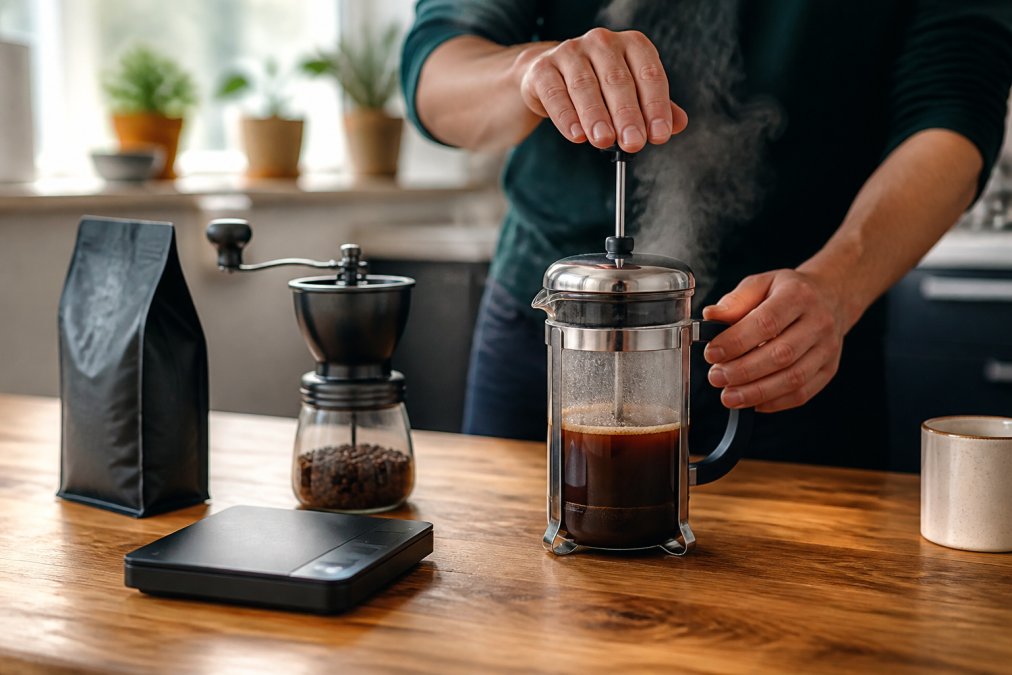
A Simple Recipe to Start
- Weigh 30g of coarse ground coffee.
- Heat water to just off the boil, around 94°C (sca.coffee).
- Add 500ml water and stir gently.
- Wait four minutes, then press slowly.
- Pour and taste before adjusting anything.
That ratio gives a balanced cup for most medium roasts. Write down what you used so you can change one variable at a time.
Adjusting to Taste
Sour, thin coffee means under-extraction: grind finer or brew longer. Bitter, harsh coffee means over-extraction: grind coarser or shorten the brew. Change one thing per cup, otherwise you will not know what worked.
Cost Comparison: Pod Coffee vs Fresh Beans
A cost comparison of pod coffee vs fresh beans usually favours beans, but the gap depends on how much you drink and what equipment you buy.
Upfront vs Ongoing Costs
Capsules carry a low entry cost and a high per-cup cost that never stops. Beans invert this: you pay once for a grinder and brewer, then a lower cost per cup for as long as you brew.
Kiboko Coffee Co bundles start at £24.99 for the Bodum French Press Bundle, £39.99 for the AeroPress Bundle, and £44.99 for the ESPRO P1 Bundle. Each includes a 250g bag ground to your method.


The more cups you brew, the faster the equipment pays for itself. Heavy capsule users reach break-even quickest.
Common Mistakes to Avoid
Most disappointing first cups trace back to a handful of fixable errors. Avoid these and your transition will be far smoother.
- Buying stale beans. Always check the roast date. Beans roasted weeks ago will taste flat no matter how well you brew.
- Skipping the grinder. Pre-ground coffee from a capsule mindset is the fastest way to conclude that beans are not better.
- Using boiling water. Water straight off the boil scalds the grounds and adds bitterness. Let it settle for a minute.
- Never cleaning your equipment. Old oils turn rancid and taint every subsequent brew.
- Changing everything at once. Dial in one variable at a time or you learn nothing.
Frequently Asked Questions
Is switching from Nespresso to a bean-to-cup machine worth it?
It depends on your priorities. Bean-to-cup machines offer convenience and fresh coffee, but they cost more upfront. If you enjoy the ritual of brewing and want to explore different beans, a manual method like a French press or AeroPress is a great start. For busy mornings, a bean-to-cup machine can be a worthwhile investment, especially if you drink multiple cups a day.
What equipment do I need to start brewing with fresh coffee beans?
At minimum, you'll need a grinder and a brewing device. A burr grinder gives you consistent grind size, which is key for flavour. For brewing, a French press or AeroPress is beginner-friendly and affordable. You'll also want a scales to measure coffee and water, and a kettle. If you prefer convenience, a bean-to-cup machine handles grinding and brewing in one.
How does the cost of fresh beans compare to Nespresso pods?
Fresh beans are often cheaper per cup. Nespresso pods typically cost 40-60p each, while a 250g bag of speciality beans (around £8-10) can make 15-20 cups, working out to 50-65p per cup. However, you'll need to factor in equipment costs. Over time, beans can be more economical, especially if you buy in bulk or subscribe. Plus, you avoid the environmental impact of single-use pods.
Do I need a separate grinder if I switch to whole beans?
Yes, unless you buy pre-ground coffee or use a bean-to-cup machine. A burr grinder is best for consistency, but blade grinders are cheaper. If you're not ready to invest, many roasters offer custom grind options so you can order beans ground to suit your brewing method. That way, you can enjoy fresh coffee without the extra equipment.
Switching from capsules to beans takes one deliberate purchase and a week of small adjustments, and the payoff is a cup you actually control. At Kiboko Coffee Co, every kilo sold donates £1 to Farm Africa, beans are roasted throughout the week for freshness, and you can choose from four grind sizes or whole bean with fast delivery. Get started with Kiboko Coffee Co and brew your first genuinely fresh cup this week.