Table of Contents
- What You'll Need to Brew Better Coffee at Home
- Start with Freshly Roasted Beans: The Non-Negotiable Step
- Coffee Brewing Ratios Explained: Finding Your Perfect Strength
- Your Coffee Grind Size Guide: Matching Grind to Method
- Master Your Water Temperature and Pouring Technique
- Troubleshooting Bitter or Sour Coffee: Quick Fixes That Work
- Your Next Steps to Brew Better Coffee Every Morning
- Frequently Asked Questions
Last Updated: September 5, 2026
Brewing better coffee at home is not about expensive machines or barista qualifications; it is about mastering a few controllable variables that transform an average cup into something exceptional. Whether you are moving on from a capsule machine or refining an existing ritual, the principles remain the same: fresh beans, the correct ratio, the right grind, and proper technique. This guide breaks down how to brew better coffee at home into simple, repeatable steps that consistently deliver a superior cup.
Most people assume their coffee tastes weak or bitter because of the machine. In reality, the culprit is almost always stale beans or an incorrect grind size. The good news is that fixing these issues takes minutes, not months of practice. Below, we’ll show you exactly how to diagnose and correct the most common brewing faults so you can enjoy café-quality results every morning.
What You'll Need to Brew Better Coffee at Home
Before you start, gather the essential kit. You do not need a commercial setup, but a few specific tools make the process predictable and repeatable. At a minimum, you will need freshly roasted whole beans, a burr grinder, a digital scale, and a kettle with temperature control if your method requires it.
The grinder is the most important purchase after the beans themselves. Blade grinders produce uneven particles, which leads to over-extraction of the fine dust and under-extraction of the larger chunks simultaneously. A burr grinder crushes beans between two surfaces for a consistent particle size. If you are using a pour-over dripper or an Aeropress, a gooseneck kettle gives you the control needed for an even saturation of the coffee bed.
Start with Freshly Roasted Beans: The Non-Negotiable Step
Freshness is the single biggest factor separating a memorable cup from a mediocre one. Roasted coffee begins to degas and oxidise the moment it leaves the roaster, and those flavour compounds fade quickly. For the best results, use beans within two to four weeks of their roast date, and always check that the bag displays a roast date rather than just a best-before stamp.
Many online retailers, including [the Specialty Coffee(/blogs/news/why-specialty-coffee-and-ethical-farming-go-hand-in-hand) Association's freshness guidance | sca.coffee], emphasise that purchasing freshly roasted coffee and using it within weeks is critical for flavour retention. This is where a subscription service shines: beans roasted throughout the week and dispatched quickly arrive at their peak. At Kiboko Coffee Co, our beans are roasted throughout the week to ensure they reach you at maximum freshness, and we donate £1 to Farm Africa for every kilo sold, so your morning ritual supports sustainable farming initiatives.
Coffee Brewing Ratios Explained: Finding Your Perfect Strength
Coffee brewing ratios explained simply: the ratio is the weight of coffee to the weight of water. The golden standard for most filter methods is 1:16, meaning one gram of coffee for every sixteen grams of water. This produces a balanced cup that highlights sweetness and acidity without becoming overly harsh.
If you prefer a stronger brew, move toward 1:14. For a lighter, tea-like body, try 1:18. The easiest way to maintain consistency is to use a digital scale rather than a scoop, as bean density varies by origin and roast level. A scoop of one bean can weigh 20% more than a scoop of another, throwing off your ratio entirely.
| Brew Strength | Coffee to Water Ratio | Best Used For |
|---|---|---|
| Strong | 1:14 | French press, milk-based drinks |
| Balanced | 1:16 | Pour-over, drip coffee |
| Light | 1:18 | Delicate single origins, iced coffee |
Your Coffee Grind Size Guide: Matching Grind to Method
Your coffee grind size guide starts with one rule: the finer the grind, the faster the extraction, so you must adjust your brew time accordingly. If the grind is too fine for your method, the water struggles to pass through, resulting in a bitter, over-extracted cup. If it is too coarse, the water rushes through and leaves you with sour, weak coffee.
Match your grind to your brewer. For a French press with a four-minute steep, use a coarse grind resembling sea salt. For pour-over methods like a V60, aim for a medium-fine consistency similar to caster sugar. Espresso requires a very fine grind, almost powdery, because the water contact time is only 25 to 30 seconds. If you are unsure where to start, most specialty roasters offer custom grind options at checkout. Kiboko Coffee Co provides four grind sizes plus whole-bean options, so you can select the exact specification for your brewer.
Master Your Water Temperature and Pouring Technique
Water temperature is a lever most home brewers ignore, yet it dramatically affects extraction. The ideal range is between 92°C and 96°C. Water that is boiling at 100°C will scald the grounds and produce a burnt, bitter flavour. If you do not have a temperature-controlled kettle, simply let your kettle rest for 30 to 45 seconds after it boils before pouring.
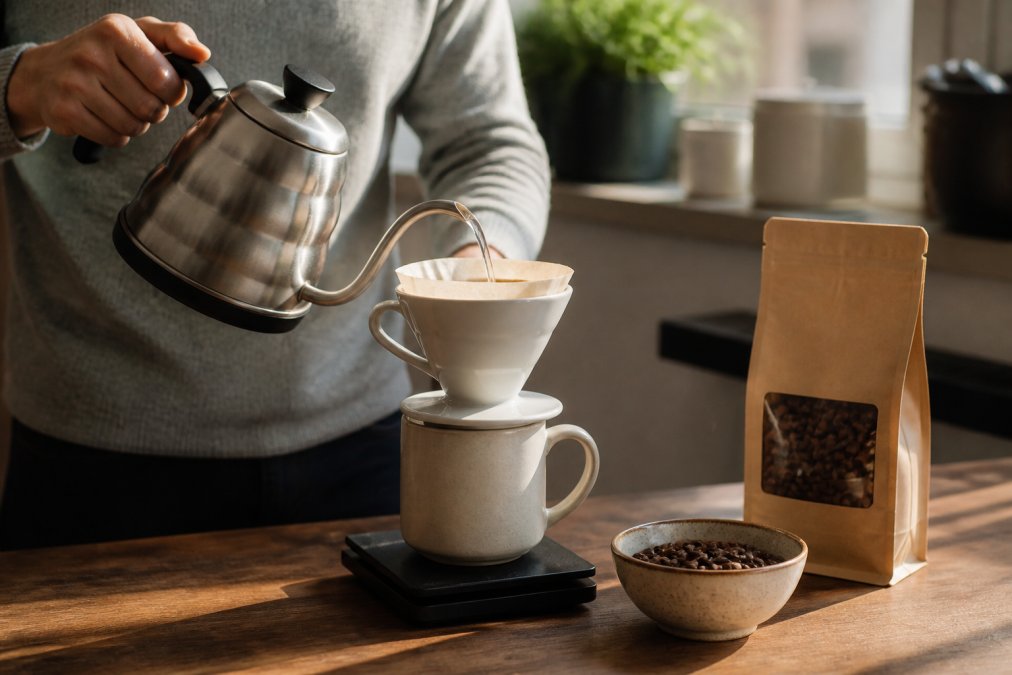
The pouring technique matters most for pour-over brewing. Start with a "bloom" pour: add roughly twice the weight of the coffee in water and let it sit for 30 seconds. This allows the coffee to degas and ensures even saturation. After the bloom, pour in slow, concentric circles, starting from the centre and working outward. Keep the water level consistent and avoid pouring directly onto the paper filter, which can cause channelling and uneven extraction.
Troubleshooting Bitter or Sour Coffee: Quick Fixes That Work
Troubleshooting bitter or sour coffee comes down to diagnosing extraction errors. Bitter coffee is usually over-extracted, meaning too much has been pulled from the grounds. Sour coffee is under-extracted, meaning not enough flavour has been dissolved. Both are fixable in under a minute.
If your coffee tastes bitter, try one of these fixes: grind coarser to speed up the water flow, lower your water temperature slightly, or shorten your brew time. If it tastes sour and sharp, do the opposite: grind finer to slow the flow, increase your water temperature, or extend your brew time. Change only one variable at a time so you can identify what actually resolves the issue.
A common mistake is adjusting the ratio when the grind is the problem. Adding more coffee to a bitter brew will not fix the bitterness; it will only make it stronger. The UK Brewers Association's extraction guidance supports this approach, noting that consistent particle size and correct brew time are the primary levers for balanced flavour. If you are consistently hitting sour or bitter notes, keep a small notebook to track your grind setting and brew time until you find the sweet spot for your specific beans.
Your Next Steps to Brew Better Coffee Every Morning
You now have the toolkit to brew better coffee consistently. Start by checking your bean freshness, then weigh your dose, match your grind to your method, and control your water temperature. These four adjustments will resolve the majority of flavour faults before you ever change your equipment.
The fastest route to a better daily cup is removing guesswork. A subscription that delivers freshly roasted beans with the correct grind for your brewer eliminates the two biggest variables: staleness and inconsistent particle size. With ethically sourced specialty coffee, custom grind options, and fast delivery across the UK, Kiboko Coffee Co makes it simple to enjoy exceptional flavour every morning without the faff of sourcing and grinding yourself. The Soil Association's certification standards highlight how transparent sourcing matters, and our commitment to supporting farming communities means every kilo you buy gives back. Get started with Kiboko Coffee Co and taste the difference fresh, properly ground coffee makes in your daily ritual.
Frequently Asked Questions
What is the golden ratio for brewing coffee?
A reliable starting point is 60 grams of coffee per 1 litre of water, which works out to roughly 1:16. This ratio suits most filter methods and produces a balanced cup. If you prefer a stronger brew, try 1:14, and for a lighter style, move toward 1:18. Adjust by small amounts until you find what tastes best to you.
Does the grind size really affect the taste of my coffee?
Yes, grind size directly controls how quickly water extracts flavour from the beans. If your grind is too fine for your method, you will likely get bitter coffee. If it is too coarse, your coffee may taste sour or weak. Use our coffee grind size guide to match the grind to your brewer, then adjust slightly based on taste.
How do I store coffee beans to keep them fresh?
Keep beans in an airtight container away from light, heat, and moisture. Avoid the fridge or freezer, as condensation damages the beans. Buy whole beans and grind only what you need just before brewing. For the best flavour, use beans within two to four weeks of their roast date.
Why does my coffee taste bitter or sour, and how do I fix it?
Bitterness usually means over-extraction, often from water that is too hot, a grind that is too fine, or a brew time that is too long. Sourness means under-extraction, typically from water that is not hot enough or a grind that is too coarse. Adjust one variable at a time to troubleshoot bitter or sour coffee effectively.