Last Updated: November 25, 2026
Quick Summary
The espresso dose for a double shot is the weight of dry ground coffee in the basket, and most double baskets take 14 g to 22 g. Match your dose to your basket's stated capacity, or a gram under it, and weigh it to 0.1 g rather than scooping by volume.
- An 18 g double basket usually works best dosed at 17.5 g to 18 g.
- Keep the brew ratio at 1:2, so an 18 g dose yields 36 g of espresso.
- Aim for a shot time of 25 to 35 seconds, treating time as a symptom not a target.
- Fix the grind first, then the yield, and change the dose last.
- Overfilling the basket causes channelling; drop the dose by 0.5 g if the puck is indented.
Table of Contents
- Why the Espresso Dose for a Double Shot Matters
- Espresso Basket Size and Dose: Matching Capacity to Grams
- The Espresso Brew Ratio: Why 1:2 Is the Starting Point
- Double Shot Espresso Yield: Weighing Output, Not Guessing Volume
- How to Dial In Espresso: A Step-by-Step Method
- Troubleshooting Dose and Extraction Problems
- Choosing Beans and Grind for Consistent Double Shots
- Stock Up on Fresh Beans and Start Pulling Better Shots
- Frequently Asked Questions
Why the Espresso Dose for a Double Shot Matters
Home baristas upgrading from capsule machines often hit this exact wall: the new setup costs more, yet the coffee can taste worse, and the problem is frequently dose.
Dose is the anchor: change it and every other variable shifts with it. That is why we treat it as rule one.
- Dose sets how much coffee the water must pass through
- More coffee means a slower, longer extraction
- Less coffee means a fast, under-extracted shot
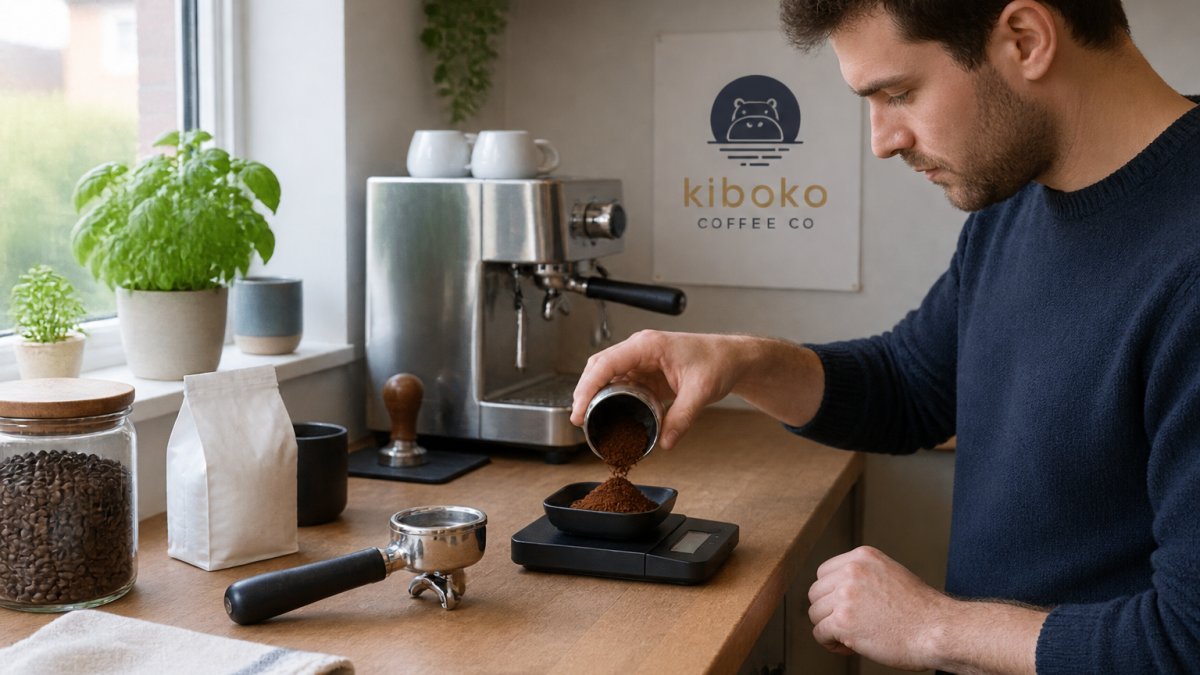
Weigh it. Do not scoop it. A scoop of light, fluffy grounds weighs far less than a scoop of fine, dense ones, so volume lies to you.
Espresso Basket Size and Dose: Matching Capacity to Grams
Basket capacity decides your dose range, not the other way round. A double basket is built to hold a certain weight of ground coffee, and overfilling or underfilling it causes channelling and messy extraction.
Most double baskets sold with home machines sit in the 14 g to 22 g range. Here is how we match dose to basket:
| Basket Capacity | Typical Dose | Best For |
|---|---|---|
| 14 g double | 14-15 g | Smaller machines, milder shots |
| 18 g double | 18-19 g | The standard home setup |
| 20 g double | 20-21 g | Stronger, richer doubles |
| 22 g triple | 22-24 g | Big milk drinks |
Check your basket's stated capacity, usually stamped on the side or in the manual. Then dose to that figure or a gram under it.
Why Overfilling Causes Channelling
Dose above the basket's capacity and the puck expands against the shower screen. Water cannot enter evenly, so it finds the path of least resistance.
Stuffing 20 g into an 18 g basket feels productive but chokes the machine, and you get a bitter, uneven shot. If you see a deep indentation in the dry puck after the shot, you are overfilled: drop the dose by 0.5 g and keep the grind the same.
Why Underfilling Causes Fast, Thin Shots
Dosing well below capacity leaves too much headspace. The puck can shift or crack when the pump starts, and water rushes through the gaps, so the shot runs fast, looks pale and tastes thin and sour. An 18 g basket dosed at 15 g will run fast unless you grind much finer, which makes the puck fragile.
Resolving Conflicting Basket Labels
Some baskets are labelled by volume rather than weight, and a few ship stamped with a range.
If your basket has no label, use the coin test. Dose, tamp, lock in, then remove the portafilter before brewing. If the puck touches the shower screen, reduce the dose. If there is a gap of more than a few millimetres, increase it slightly.
Matching Dose to Grind and Shot Behaviour
Dose and grind are linked. A larger dose needs a coarser grind to keep the same shot time, because there is more coffee for the water to pass through; a smaller dose needs a finer grind.
As a starting point, keep the yield ratio fixed at 1:2 and adjust grind until the shot runs in 25 to 35 seconds. Then taste: sour means grind finer, bitter means grind coarser. Only after that consider a small dose change.
Single Basket vs Double Basket
A single basket holds roughly 7 g to 10 g and produces a smaller, sharper shot. A double basket holds 14 g to 22 g and gives you more crema, more body and far more room for error.
Most home baristas find it easier to start on a double. Single baskets can be fussy, and their shallow puck is unforgiving of grind mistakes.
A Note on Caffeine and Serving Size
A double basket does not guarantee a fixed caffeine amount. Caffeine depends on the bean, roast level, dose and extraction: a 20 g dose of a dark roast can deliver more caffeine than an 18 g dose of a light roast, and a longer yield extracts more than a shorter one.
If you want a consistent serving, weigh your dose and yield every time. That is the only way to know what is in the cup.
The Espresso Brew Ratio: Why 1:2 Is the Starting Point
The espresso brew ratio is the weight of your liquid output compared with your dry dose, and 1:2 is the sensible starting point for most beans.
1:2 balances sweetness and strength without demanding pinpoint grind accuracy. It is the modern standard for a reason.
- 1:2 gives a classic, syrupy double
- 1:2.5 opens up fruity, light-roast beans
- 1:3 produces a longer, tea-like lungo
Start at 1:2. Taste it. Then nudge the ratio before you touch anything else.
Double Shot Espresso Yield: Weighing Output, Not Guessing Volume
Double shot espresso yield is best measured in grams on a scale, not in millilitres in a shot glass.
Put a small scale under your cup and stop the shot at your target weight. That is the whole trick.
Mass and volume are not the same: two shots that look identical in a glass can differ by several grams, and that difference shows up in the cup.
- Weigh your dry dose first
- Weigh your liquid output second
- Record both numbers every time
This habit alone fixes most inconsistency. You cannot repeat a shot you never measured.
How to Dial In Espresso: A Step-by-Step Method
Learning how to dial in espresso is a loop of three adjustments, run in a fixed order. Change one thing at a time, taste, and repeat. Skip that discipline and you will never know what fixed the shot.
For a wider look at brewing at home, our guide to brewing speciality coffee at home covers the full routine around these steps.
Step 1: Set Your Dose
Pick your basket's capacity and lock that dose in. Weigh it to 0.1 g every single time.
A common pattern is to start at the basket's stated capacity minus half a gram. An 18 g basket usually behaves well at 17.5 g to 18 g.
Watch out: if the puck touches the shower screen before you lock the portafilter in, the basket is overfilled.
Step 2: Fix Your Yield and Time
Choose your ratio, weigh the output, and note the time. A double shot usually runs somewhere between 25 and 35 seconds.
Put the cup on a scale, tare it, and start the pump. Stop the shot when the scale reads your target yield.
If the shot finishes in 18 seconds at 36 g, the grind is too coarse.
Step 3: Adjust the Grind
If the shot ran fast and tastes sour, grind finer. If it ran slow and tastes bitter, grind coarser. Keep the dose and yield fixed while you do this.
Make one grind adjustment at a time. On most home grinders, one or two clicks shifts the shot time by several seconds. Pull another shot, weigh the yield, note the time and taste.
Step 4: Taste and Decide What to Change Next
Once the shot is in the time window, taste it. If it is sour and thin, the extraction is under-developed.
If it is bitter and dry, the extraction has gone too far. Grind coarser or reduce the yield. Again, change only one.
A useful rule of thumb: fix the grind first, then the yield, then the dose.
Step 5: Record and Repeat
Keep a simple log: dose, yield, time, grind setting and a one-word taste note. After five or six shots you will see the pattern.
This loop is the whole method. Weigh the dose, fix the yield, adjust the grind, taste, and change one variable at a time. It works on any machine and any basket, and it turns a vague gram range into a repeatable recipe.
Troubleshooting Dose and Extraction Problems
Most dosing faults show up in the cup before they show up anywhere else. Here is how we read them.
| Problem | Likely Cause | Fix |
|---|---|---|
| Shot runs in under 20 seconds | Grind too coarse or dose too low | Grind finer, check dose weight |
| Shot chokes and drips slowly | Grind too fine or basket overloaded | Grind coarser, dose to capacity |
| Sour, thin taste | Under-extraction | Finer grind or slightly higher yield |
| Bitter, dry finish | Over-extraction | Coarser grind or shorter yield |
| Messy, spurting puck | Uneven tamp or dose too high | Level the bed, reduce dose |
If your shot is pulling fast and sour, our focused fix-it guide on why your espresso shot pulls too fast walks through grind, dose and puck corrections in more detail.
Choosing Beans and Grind for Consistent Double Shots
Freshness and roast level change how a dose behaves, so your beans are part of the recipe.
A common mistake is buying a big bag and grinding it all at once. Grind per shot, straight into the basket.
Which beans suit a double shot? Our Nyumba Blend is a medium roast with pecan, toffee and milk chocolate notes, and it is built for espresso, where its caramel sweetness builds a beautiful crema. If you want to compare styles first, our piece on single origin coffee versus blends explains the trade-offs.
Dark roast lovers should try Usiku or Shujaa. Usiku is built for espresso machines and moka pots, while Shujaa is purpose-built for milk-based drinks.
Stock Up on Fresh Beans and Start Pulling Better Shots
Consistency is the whole game here. Weigh your dose, weigh your yield, and change one variable at a time.
We roast to demand in small batches, rest the beans and pack them before dispatch.
Ready to put these rules into practice? Our espresso blend bundle guide helps you choose the right bag before you commit.
Your next shot is a chance to prove the method works.
Get started with Kiboko Coffee Co and pull a sweeter, more consistent double shot from your very next bag.
Frequently Asked Questions
How many grams of coffee do you need for a double shot of espresso?
Most double baskets take between 16 g and 20 g of ground coffee, with 18 g being the common starting point. A 14 g double basket suits 14 to 16 g, while larger 20 g and 21 g baskets take 20 to 22 g. Always dose to the basket's rated capacity, then adjust within that range to taste. Weighing every dose on a digital scale is the only reliable way to keep shots consistent from one morning to the next.
What is the ideal espresso brew ratio for a double shot?
Start with a 1:2 brew ratio: 18 g of coffee in, 36 g of espresso out. This sits between the ristretto end (1:1.5) and the lungo end (1:3) and gives a balanced shot for most beans. A dark roast may taste better closer to 1:1.5, while a light roast often needs 1:2.5 or 1:3 to open up. Treat the ratio as a starting point and adjust based on whether the shot tastes sour or bitter.
How much should a double shot yield in millilitres?
A double shot typically yields around 36 g of liquid, which is roughly 36 ml, though crema makes the volume look larger in the cup. Because crema traps gas, volume is an unreliable measure. Weigh your output on a scale instead of judging by eye. If you must use a volume measure, treat 30 to 40 ml as a rough guide, but expect the weight to be the more consistent number.
How do you adjust the dose if the shot tastes sour or bitter?
Sour, thin shots usually mean under-extraction: try a finer grind or a slightly higher yield before changing the dose. Bitter, harsh shots point to over-extraction: coarsen the grind or shorten the yield. Change one variable at a time and taste again. If the shot still tastes wrong after grind and yield adjustments, move the dose by 1 g within the basket's range and repeat the process.