Table of Contents
- What You'll Need Before You Start Brewing
- Step 1: Choose Your Brewing Method
- Step 2: Get Your Coffee to Water Ratio Right
- Step 3: Why the Importance of a Burr Grinder Cannot Be Overstated
- Step 4: Brew Your Specialty Coffee at Home
- Troubleshooting Bitter or Sour Coffee
- Storing Your Beans to Keep Them Fresh
- Frequently Asked Questions
Last Updated: 17 September 2026
What You'll Need Before You Start Brewing
Learning how to brew specialty coffee at home starts with a short, honest equipment list. This guide from Kiboko Coffee Co covers the essentials, the ratios, and the fixes for the two most common faults: bitterness and sourness.
You do not need a laboratory. You need four things: fresh beans, a burr grinder, a scale, and a brewing method you will actually use on a Tuesday morning. Everything else is refinement.
Here is the core kit:
- Freshly roasted whole beans, ideally within two to four weeks of the roast date
- A burr grinder, hand or electric
- A digital scale reading to 0.1g
- A brewing device: AeroPress or French press to start
- Filtered water and a gooseneck kettle if your method benefits from control
Step 1: Choose Your Brewing Method
Your brewing method decides how much body and clarity end up in the cup. AeroPress and French press sit at opposite ends of that spectrum, and both are excellent places to start.

For a broader view of what is possible at home, [Specialty Coffee(/blogs/news/best-specialty-coffee-subscription-uk-2026) Association brewing guidance | sca.coffee] publishes standards on extraction and water quality that apply to every method below.
AeroPress: For Fast, Clean Cups
The AeroPress produces a clean, low-sediment cup in about two minutes. Its paper micro-filter traps oils and fine particles, so flavours read as distinct rather than muddy. It suits lighter roasts and single origins where you want clarity. The AeroPress Original comes with 350 micro-filters, a stirrer, scoop, and filter cap, so there is nothing extra to buy on day one.

French Press: For Full-Bodied Flavour
The French press keeps the oils in the cup, which is why it tastes richer and heavier. Its metal mesh filter lets fine particles through, so expect more sediment and a rounder mouthfeel. The Bodum French Press Cafetière uses heat-resistant borosilicate glass that will not alter the coffee's natural flavour, with a stainless steel plunger and filter and a 0.35L capacity. It is dishwasher safe, which matters more than most reviews admit.
| Method | Brew Time | Filter | Cup Profile | Best For |
|---|---|---|---|---|
| AeroPress | 1.5-2.5 min | Paper micro-filter | Clean, bright, low sediment | Lighter roasts, single origins |
| French press | 4 min steep | Stainless steel mesh | Full-bodied, oily, some sediment | Richer, heavier cups |
Step 2: Get Your Coffee to Water Ratio Right
The coffee to water ratio is the single biggest lever you control, and it is measured by weight, not scoops. Start at 60g of coffee per litre of water, which scales to 15g of coffee and 250g of water for one mug.
That 1:16.6 starting point sits in the middle of the standard range. If the cup tastes weak, tighten the ratio toward 1:15. If it tastes heavy or harsh, loosen it toward 1:17. Change one variable at a time and taste before adjusting again.
Weigh your water, not just your coffee. A mug filled to the same visual line holds different amounts depending on its shape, and eyeballing it is the fastest way to inconsistent results. A scale removes the guesswork entirely.
Step 3: Why the Importance of a Burr Grinder Cannot Be Overstated
A burr grinder crushes beans between two shaped surfaces to produce particles of a consistent size. Blade grinders chop instead, leaving a mix of dust and boulders that extract at different rates, which is why the same beans can taste bitter and sour in the same cup.
Grind size also changes by method. AeroPress wants a medium-fine grind, closer to table salt. French press wants a coarse grind, closer to sea salt, because a fine grind will slip past the mesh filter and leave sludge in the cup.
If you are not ready to buy a grinder, order your beans ground to suit your device. Kiboko Coffee Co offers four grind sizes plus whole bean, and roasts throughout the week so the coffee arrives fresh rather than warehouse-stale. A common mistake is buying a large bag of pre-ground coffee and taking a month to finish it; the aromatics fade long before the bag is empty.
Step 4: Brew Your Specialty Coffee at Home
Brewing specialty coffee at home is a repeatable four-step process: heat water, weigh and grind, combine for a set time, then separate the coffee from the grounds. The variables are time, temperature, and grind, and both methods below keep them simple.
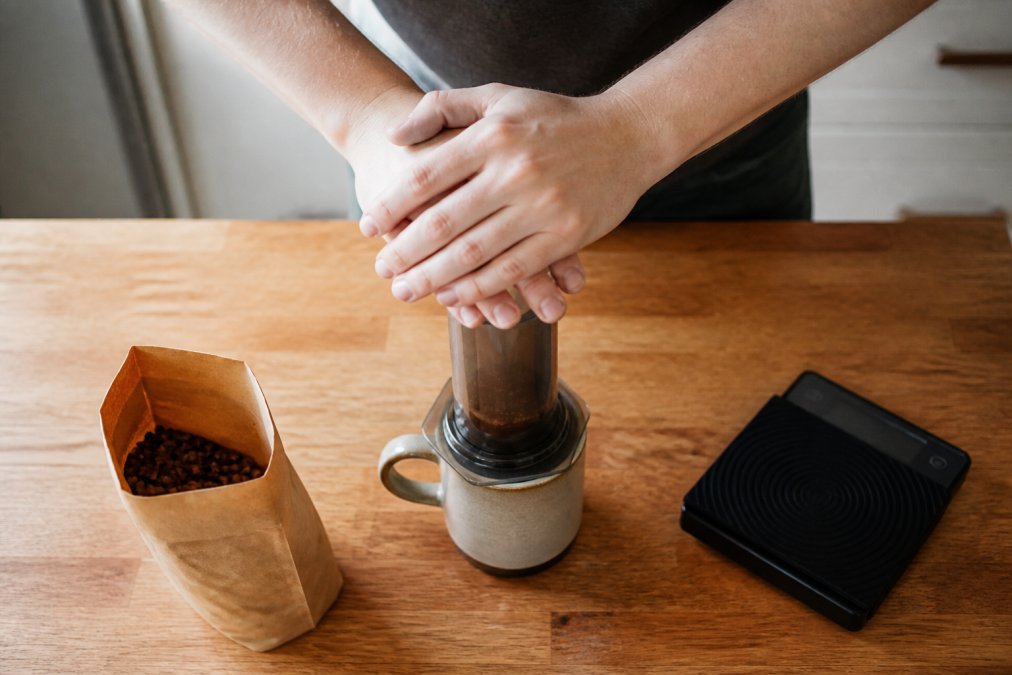
Brewing with an AeroPress
- Heat water to roughly 85-92C for lighter roasts.
- Weigh 15g of coffee and grind medium-fine.
- Add the grounds to the chamber and pour 250g of water.
- Stir for 10 seconds, then steep for 60 seconds.
- Cap, press slowly over 20-30 seconds, and stop at the hiss.
Slow, even pressure makes the difference here. Pressing hard forces water through too quickly and leaves the bed unevenly extracted.
Brewing with a French Press
- Heat water to roughly 92-96C.
- Weigh 30g of coffee and grind coarse.
- Add grounds to the carafe and pour 500g of water.
- Stir once, then steep for 4 minutes.
- Press the plunger down slowly and pour immediately.
Do not leave the coffee sitting on the grounds after pressing. Extraction continues, and a cup that tastes balanced at four minutes will taste bitter at eight.
Troubleshooting Bitter or Sour Coffee
Troubleshooting bitter or sour coffee comes down to extraction: bitterness means you extracted too much, sourness means you extracted too little. Both are fixable in one brew, and neither means your beans are bad.
| Taste | Likely Cause | Fix | What to Change Next |
|---|---|---|---|
| Bitter, dry, harsh | Over-extraction | Grind coarser | Lower water temp by 2-3C |
| Sour, thin, sharp | Under-extraction | Grind finer | Raise water temp by 2-3C |
| Weak but not sour | Too little coffee | Tighten ratio to 1:15 | Check your scale is accurate |
| Muddy, silty | Grind too fine for method | Grind coarser | Check filter seating |
Adjust grind size first, because it changes extraction faster than anything else. Water temperature is your second lever. Change both at once and you will not know which one fixed it.
Storing Your Beans to Keep Them Fresh
Store beans in an airtight container, away from light, heat, and moisture, at room temperature. Do not refrigerate them, and only freeze them if you are storing a large quantity for long-term use.
The enemies of freshness are oxygen, light, heat, and moisture, in roughly that order. A sealed opaque container in a cool cupboard beats a decorative glass jar on a sunny windowsill every time.
Buy in quantities you will finish within a few weeks. Coffee is an agricultural product, and like any fresh food, it declines with time. If you drink one cup a day, a 250g bag is a sensible size; if you brew for two, buy larger and share the freshness window.
For official guidance on safe water quality, which affects how your coffee tastes, Drinking Water Inspectorate guidance is a useful reference for what comes out of the tap.
Switching from capsules to proper brewing is the hardest part, and it is almost entirely about building one repeatable routine. Kiboko Coffee Co exists to make that routine easier: ethically sourced specialty coffee with £1 donated to Farm Africa for every kilo sold, roasted throughout the week for freshness, four grind sizes plus whole bean to match your device, and fast delivery.
Frequently Asked Questions
What is the golden ratio for brewing specialty coffee?
The golden ratio for brewing specialty coffee is generally between 1:15 and 1:17, meaning one part coffee to 15-17 parts water. For a standard 250ml cup, that means using roughly 15-17g of coffee. If you prefer a stronger cup, try 1:15. For a lighter, more delicate brew, go closer to 1:17. Always use a scale for accuracy, as volume measurements like scoops vary widely and will affect your consistency.
Why is a burr grinder essential for home brewing?
A burr grinder crushes beans between two abrasive surfaces to produce uniform particles. This even grind size ensures consistent extraction, so you don't get a mix of sour and bitter flavours in the same cup. Blade grinders chop unevenly, creating fines that over-extract and boulders that under-extract. For anyone serious about how to brew specialty coffee at home, a burr grinder is the single most impactful upgrade you can make to your setup.
How do I troubleshoot bitter or sour coffee?
If your coffee tastes bitter, it is likely over-extracted. Try a coarser grind, lower the water temperature slightly, or shorten the brew time. If it tastes sour or sharp, it is under-extracted. Use a finer grind, increase the water temperature, or extend the brew time. Change one variable at a time and taste the result. Keep notes so you can repeat what works. Small adjustments of 10-15 seconds or a few degrees make a noticeable difference.
How should I store specialty coffee beans to maintain freshness?
Store beans in an airtight container away from light, heat, and moisture. A cupboard near the kettle is a poor spot because of steam and warmth. Keep the bag sealed or transfer to a vacuum container. Buy in smaller quantities, around 250g, so you finish them within two to four weeks of the roast date. Avoid the fridge because condensation damages the beans. A cool, dark cupboard is ideal.