Table of Contents
- Why Coffee Grind Size Matters
- Understanding the Coffee Grind Size Chart
- Coffee Grind Size for Cafetière
- Coffee Grind Size for Espresso
- How to Adjust Coffee Grind Size
- Matching Grind Size to Your Brewing Method
- Common Mistakes to Avoid
- Frequently Asked Questions
Last Updated: 20 October 2026
Why Coffee Grind Size Matters
The grind size you choose determines how water interacts with your coffee grounds. Get it right, and you extract the best flavours. Get it wrong, and your brew tastes bitter, sour, or flat.
Think of it this way: grind size controls extraction time. Finer grounds have more surface area, so water reaches them faster. Coarser grounds take longer. Your brewing method dictates which speed works best.
At Kiboko Coffee Co, we've watched countless home brewers struggle with inconsistent results. The culprit? They were using the same grind for every brewing method. A cafetière needs something completely different from espresso. Understanding coffee grind size is the foundation of better coffee at home.
Here's what changes when you adjust grind size:
- Finer grinds extract faster (more bitterness risk)
- Coarser grinds extract slower (more sourness risk)
- The right grind hits the sweet spot for your method
- Consistency matters as much as size
Understanding the Coffee Grind Size Chart
A coffee grind size chart shows the progression from powder-fine to chunky pieces. Each size serves a purpose. Most home brewers need just three or four sizes to cover every brewing method they own.
The chart runs from extra coarse to extra fine. Think of it as a spectrum, not strict categories. One grinder's "medium" might be another's "medium-coarse." What matters is matching the grind to your method and tasting the results.
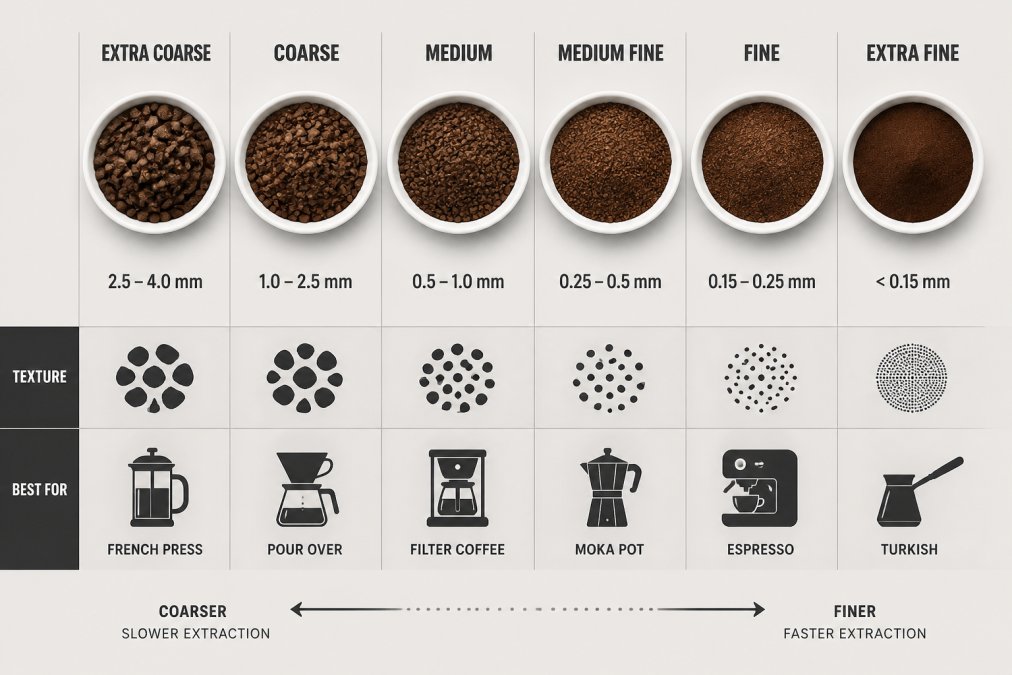
Extra Coarse
Extra coarse looks like breadcrumbs or sea salt. The particles are large and separate from each other. Water moves through them quickly.
Use extra coarse for cold brew and cowboy coffee (boiling water poured directly over grounds in a pot). These methods need long steeping times or very fast water movement. Fine grounds would turn your cold brew into mud.
Coarse
Coarse grind resembles rough sand. It's the size most people think of when they picture ground coffee.
This is your cafetière grind. The Bodum French Press at Kiboko Coffee Co works beautifully with coarse grounds because the metal filter lets oils and fine particles through. Coarse grounds give you full-bodied coffee without over-extraction.

Medium-Coarse
Medium-coarse sits between coarse and medium. It's noticeably finer than sand but still has visible particles.
Chemex brewers and some pour-over methods prefer this size. It's a bridge between fast and slow extraction. If you're new to pour-over brewing, start here and adjust based on taste.
Medium
Medium grind looks like table salt. It's the most common size you'll find in supermarket bags.
This grind works for drip coffee makers and some manual pour-over methods. It's versatile enough that many home brewers default to it. However, it's rarely the best choice for any single method, it's the compromise choice.
Medium-Fine
Medium-fine is noticeably powdery but still has some texture. You can see individual particles, but they're small.
AeroPress brewers often use medium-fine because the method combines immersion and pressure. The short brew time needs finer grounds to extract properly. If you own an AeroPress, this is worth experimenting with.
Fine
Fine grind looks like flour or icing sugar. It's powder-like but not quite dust.
Pour-over enthusiasts often prefer fine grind for slower drip rates. Turkish coffee requires fine grind, nearly powder-fine, actually. Fine grind extracts quickly, so watch your brew time carefully to avoid bitterness.
Extra Fine
Extra fine is powder. It's what you'd get if you ground coffee in a spice grinder for several minutes.
Turkish coffee is the primary use for extra fine grind. The grounds settle at the bottom of the cup. If you're making Turkish coffee, you need extra fine. For everything else, it's usually too fine and causes over-extraction.
Coffee Grind Size for Cafetière
A cafetière needs coarse grounds. This is non-negotiable if you want good results.
Here's why: a cafetière brews by immersion. You steep grounds in hot water for about four minutes, then press down a metal filter. The metal mesh is large enough to let fine particles through. If you use fine grounds, you'll get sediment in your cup and bitter over-extraction.
Coarse grounds give you full-bodied, clean coffee. The metal filter captures the larger pieces. The longer brew time (four minutes) lets coarse grounds extract properly without becoming bitter.
Common mistake: using medium or medium-fine grind in a cafetière. This produces cloudy, over-extracted coffee. Stick with coarse, and you'll notice the difference immediately.
The Bodum French Press Cafetière Coffee Maker from Kiboko Coffee Co is designed for this. Its stainless steel plunger and filter work best with coarse grounds. Pair it with our coarse-ground speciality beans, and you've got a reliable brewing setup.
Coffee Grind Size for Espresso
Espresso requires fine grind. The process is completely different from immersion brewing.
Espresso forces hot water through grounds under pressure. The contact time is short, just 25 to 30 seconds. To extract enough flavour in that time, you need fine grounds with maximum surface area.
If your grind is too coarse, water rushes through without extracting. You get sour, weak espresso. If it's too fine, water can't push through, and the machine struggles.
Fine grind for espresso is finer than pour-over fine. It's closer to powder. Many home espresso machines come with a grinder that offers an espresso setting, use it as your starting point, then dial in from there.
The challenge with espresso is consistency. A tiny adjustment in grind size changes the shot dramatically. Most home baristas dial in their grinder by pulling shots and tasting them, adjusting finer or coarser based on the result.
How to Adjust Coffee Grind Size
Start with your brewing method's recommended grind size. Then taste and adjust.
If your coffee tastes sour or thin, go finer. Finer grounds extract more, pulling out the sugars and acids that create body and sweetness. Move one notch finer on your grinder dial.
If your coffee tastes bitter or harsh, go coarser. Coarser grounds extract less, reducing over-extraction. Move one notch coarser.
Most grinders have numbered dials or settings. The numbers don't mean the same thing across brands, so ignore the numbers and focus on the taste. Adjust one setting at a time. Brew the same volume of water and grounds each time so you're testing only the grind change.
Keep notes. Write down which grind setting worked best for each brewing method you own. This saves time when you buy new beans.
A burr grinder gives you finer control than a blade grinder. If you're serious about dialling in your coffee, a burr grinder is worth the investment. Kiboko Coffee Co offers custom grind options when you order, so you can test different sizes without owning multiple grinders.
Matching Grind Size to Your Brewing Method
Each brewing method has a grind size sweet spot. Match the grind to the method, and extraction becomes predictable.
Pour-over brewers
Pour-over methods (Chemex, V60, Melitta) need medium to medium-fine grind. Water flows through the paper or ceramic filter at a controlled rate.
The grind size controls how fast water moves through the grounds. Too coarse, and water rushes through without extracting enough. Too fine, and the filter clogs, slowing extraction too much.
Start with medium-coarse and taste. If it's sour, go finer. If it's bitter, go coarser. Most pour-over brewers settle on medium or medium-fine.
AeroPress and similar immersion methods
The AeroPress uses both immersion and pressure. You steep grounds for a short time, then press hot water through them.
Medium-fine grind works well here. The short brew time (one to two minutes) needs finer grounds to extract properly. The pressure from pressing helps extract, so you don't need to go as fine as espresso.
The ESPRO P1 Travel Coffee Press from Kiboko Coffee Co works similarly. Its dual-layer mesh filter and pressure system pair well with medium-fine grounds. You get clean, full-bodied coffee in minutes.

Turkish coffee
Turkish coffee demands extra fine grind, nearly powder-like. You add grounds directly to water in a special pot called a cezve or ibrik.
The grounds settle at the bottom of your cup. This method extracts quickly and intensely. Extra fine grind ensures proper extraction in the few minutes it takes to heat the water to a foam.
Turkish coffee is an art form. The grind is just one variable. Water temperature, timing, and technique all matter. But without extra fine grind, you won't get authentic results.
Common Mistakes to Avoid
Using the wrong grind size is the most common reason home coffee tastes disappointing. Here's what to watch for:
Using medium grind for everything. Medium is the compromise size. It's rarely the best choice for any specific method. Your cafetière deserves coarse. Your pour-over deserves medium-fine or fine. Test the recommended size for your method.
Not adjusting when you change methods. If you switch from a cafetière to a pour-over, your grind size needs to change too. Don't assume yesterday's setting works today.
Buying pre-ground coffee and expecting consistency. Pre-ground coffee loses freshness quickly. The grind size is fixed to whatever the roaster chose. Whole bean coffee stays fresh longer and lets you grind to your exact needs.
Assuming all grinders produce the same results. A blade grinder creates inconsistent particle sizes. A burr grinder produces uniform grinds. If you're serious about coffee, a burr grinder is the upgrade that matters most.
Over-extracting because the grind is too fine. Fine grind is not always better. Finer means faster extraction. If your grind is too fine for your method, you'll taste bitterness and harshness. Start coarser and adjust up if needed.
Choosing the right coffee grind size transforms your home brewing. The difference between sour, weak coffee and balanced, flavourful coffee often comes down to this single variable. Start with the recommended grind for your brewing method, then adjust based on taste. Within a few brews, you'll dial in your perfect extraction.
At Kiboko Coffee Co, we roast specialty beans fresh throughout the week and offer custom grind options to match your brewing method. Our ethically sourced single-origin and blended coffees deserve the right grind. Shop our range now and experience the difference fresh, properly ground coffee makes in your cup.
Frequently Asked Questions
What grind size should I use for each coffee brewing method?
Grind size depends on how long water contacts the coffee grounds. Immersion methods like cafetières need coarse grinds to prevent over-extraction. Espresso requires fine grinds for pressure-based extraction. Pour-over brewers typically use medium grinds. Turkish coffee demands extra-fine grounds. Matching grind size to your brewing method ensures optimal flavour extraction and prevents bitter or weak coffee.
How do I know if my coffee grind is too fine or too coarse?
If your coffee tastes bitter or astringent, the grind is likely too fine, allowing over-extraction. If it tastes weak or sour, the grind is probably too coarse, resulting in under-extraction. Adjust gradually in small increments. With a cafetière, coarse grounds should feel gritty between your fingers. Fine grounds should resemble flour or talcum powder. Taste is your best guide, experiment until you find your preferred balance.
Can I use the same grind size for different coffee makers?
No. Each brewing method has an optimal grind size based on extraction time and water pressure. Using the wrong size produces inconsistent results. For example, espresso machines require fine grinds to create pressure resistance, whilst cafetières need coarse grinds to prevent grounds escaping through the mesh filter. If you own multiple brewing methods, you'll benefit from a burr grinder that offers adjustable settings. Kiboko Coffee Co offers four grind sizes plus whole beans, so you can select the perfect grind for your specific brewing method.
Does grind size affect coffee flavour?
Yes, significantly. Grind size controls extraction speed and the surface area exposed to water. The correct grind size unlocks the bean's full flavour potential, bright acidity, balanced sweetness, and complex notes. Incorrect grind sizes mask flavour or introduce unwanted bitterness. With specialty-roasted beans like those from Kiboko Coffee Co, using the proper grind size ensures you experience the distinct flavour profiles the roaster intended, whether you're brewing a single-origin bean or a carefully crafted blend.