Last Updated: November 4, 2026
Quick Summary
Often, but it depends on the farm. Shade-grown coffee can support biodiversity, bird habitat, soil health and carbon storage, yet the label alone tells you little about canopy diversity or farm management. Check the tree species, canopy density and certifications before buying.
- Shade-grown farms can support more bird species, especially where the farm sits within forested land.
- Leaf litter and pruned branches add organic matter that improves soil structure and water holding.
- Shade systems usually yield less per hectare than sun-grown coffee, so more land may be needed.
- Organic certification says little about shade; bird-friendly certification assesses canopy cover directly.
- Check whether a bag names the farm, region or lot, and whether the certification is specific and traceable.
Table of Contents
- What Shade-Grown Coffee Actually Means
- Shade-Grown vs Sun-Grown Coffee: The Real Differences
- The Environmental Benefits of Shade-Grown Coffee
- Where Shade-Grown Coffee Falls Short
- Sustainable Coffee Certifications: What the Labels Really Tell You
- How to Choose Sustainable Coffee With Confidence
- Choosing Your Next Bag of Better Coffee
- Frequently Asked Questions
Kiboko Coffee Co sources and roasts coffee for UK home brewers, and a question we hear often is a simple one: is shade-grown coffee actually better for the environment? The honest answer is "often, but it depends." Shade-grown coffee has real environmental advantages over many sun-grown farms, yet the label alone doesn't tell you much. This guide explains what shade-grown coffee means, where its benefits come from, where it falls short, and how to check a bag before you buy.
What Shade-Grown Coffee Actually Means
Shade-grown coffee is coffee grown beneath a canopy of trees rather than in open, fully exposed fields. The trees can be native species, fruit trees or timber trees, and the coffee bushes grow in their filtered light.
The term covers many farms. Some are close to natural forest, with dense tree cover and many plant species. Others are simply coffee planted under a few shade trees. Because the label is so broad, two bags marked "shade-grown" can come from very different farming systems.
Coffee plants originally grew as understorey shrubs in forests, so shade is closer to their natural conditions. That is why shade systems are often described as more traditional, though modern farms have changed a great deal since then.
Shade-Grown vs Sun-Grown Coffee: The Real Differences
Sun-grown coffee is planted in open fields with little or no tree cover.
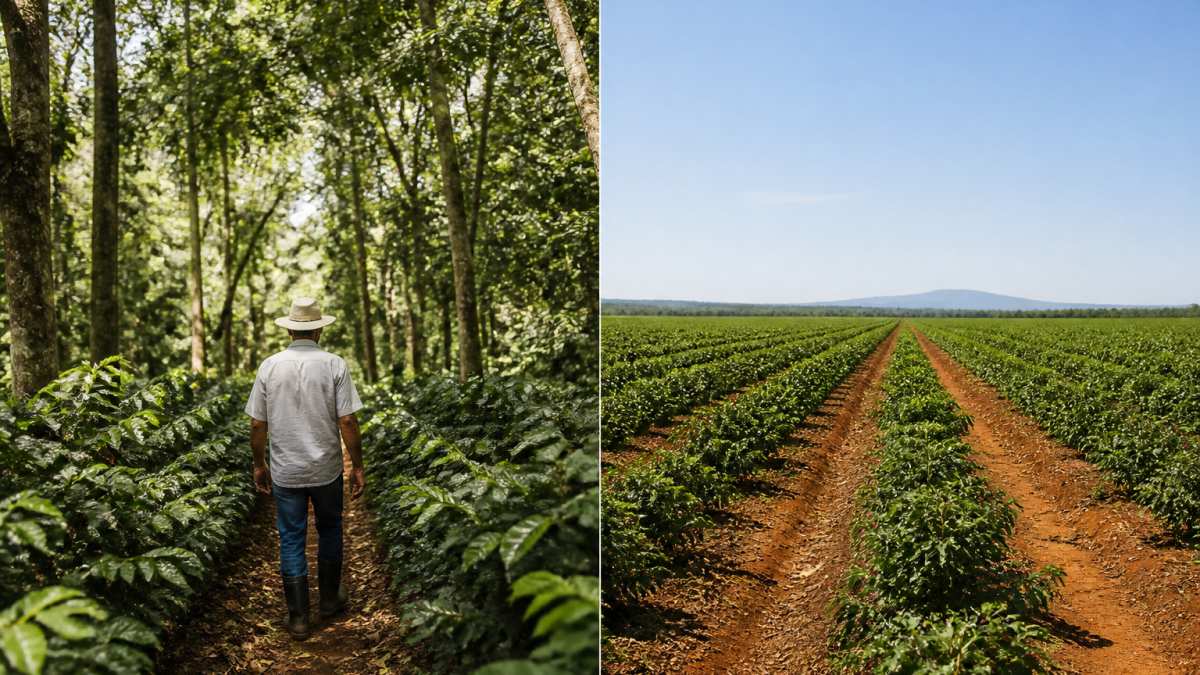
Shade-grown systems tend to produce lower yields per hectare. Farmers may also get a second income from timber or fruit, which can make the system more resilient when coffee prices fall.
The gap is not always large, though. A well-managed sun-grown farm with good soil care can outperform a neglected shade farm. Shade does not guarantee good practice, and sun does not guarantee poor practice.
Quick check: Shade-grown means more tree cover, not automatically less pollution, higher quality or fairer pay.
The Environmental Benefits of Shade-Grown Coffee
Shade-grown farms can deliver a wide range of environmental benefits, but the size of those benefits depends on the type of shade system, the species of trees and how the farm is managed. It helps to separate three things: what the trees do, what the soil does, and what the farm avoids doing.
Biodiversity, Bird Habitat and Soil Health
A diverse canopy behaves like a small woodland. Native trees, fruit trees and timber trees in a mixed stand create layers of habitat, leaf litter, understorey, mid-canopy and emergent crowns, that support insects, reptiles, amphibians, mammals and birds. Simplified shade, where a single species is planted at low density, supports far less.
Shade farms with a complex canopy and nearby forest often host a greater number of resident and migratory bird species than open coffee, because the trees provide foraging, nesting and cover.
Soil health follows the same logic. Fallen leaves and pruned branches add organic matter, which feeds soil life, improves structure and helps the soil hold water. Tree roots and ground cover reduce erosion, so less topsoil and fewer nutrients wash into streams.
Carbon Storage, Water Retention and Climate Limits
Trees store carbon in trunks, branches and roots, and the soil beneath them can hold carbon as well. A dense, mixed shade system will generally store more carbon per hectare than open coffee, but the figure depends on tree density, species, age and whether the wood is harvested.
Tree cover moderates temperature and helps soil retain moisture, which can buffer coffee plants during dry spells and heat stress. That buffering is real but limited. Excessive shade can reduce photosynthesis and yields, and in cool or humid areas it can encourage fungal disease. Shade is not a substitute for rainfall, and it does not remove the pressure of a changing climate, it softens some of it.
What Shade Systems Avoid
Shade systems can reduce reliance on synthetic fertilisers and pesticides, because a diverse canopy supports predators and pollinators and recycles nutrients through leaf litter. That reduction is a genuine environmental gain, but it is not automatic: a shade farm can still apply chemicals heavily, and a well-managed sun-grown farm can use fewer inputs than a neglected shade farm. The label describes the canopy, not the chemical regime.
Where the Benefits Are Largest
The environmental case is strongest when four conditions hold together: the canopy is diverse and native-led, tree cover is dense enough to create real habitat, the farm retains organic matter and controls erosion, and the surrounding landscape still has forest. When those conditions are missing, shade-grown coffee may offer only a modest improvement over sun-grown coffee, and sometimes less than a well-run open farm. Because these ecological benefits depend on how a farm is managed and where it sits, they offer a more useful basis for judging shade-grown coffee value than the label alone.
The size of these benefits depends on how the shade system is built and managed, and the main gains fall into three areas.
| Benefit | Where it comes from | Limiting factor |
|---|---|---|
| Biodiversity and bird habitat | Diverse canopy with layered habitat | Simplified or isolated shade gives far less |
| Soil health | Leaf litter and organic matter; roots and ground cover | Benefit depends on active soil management |
| Carbon storage | Trunks, branches, roots and soil carbon | Varies with tree density, species and harvesting |
| Water retention | Tree cover moderates temperature and moisture | Excess shade can cut yields and encourage fungal disease |
| Fewer chemical inputs | Canopy supports predators and recycles nutrients | Not automatic; the label describes the canopy, not the chemicals used |
Where Shade-Grown Coffee Falls Short
Shade-grown coffee is not automatically the greenest choice in every case. Some points readers should weigh:
- Land use: Lower yields can mean more land is needed to produce the same amount of coffee.
- Variation: A shade farm with poor tree choice or weak management may deliver few benefits.
- Water and processing: Water use and pollution depend largely on how beans are washed and processed, which the shade label does not tell you.
- Transport: Shipping coffee across the world adds emissions regardless of how it was grown.
- Labels: "Shade-grown" is not always independently verified, so a claim on its own deserves a second look.
A practical way to judge a farm is to ask what the trees are, how dense the canopy is, and how the farm treats its soil and water.
Sustainable Coffee Certifications: What the Labels Really Tell You
Certifications can help you check environmental and social claims, but each one measures different things and sets different thresholds. To go beyond the logo itself, see how to verify ethical coffee sourcing step by step. Treat a seal as a starting point for questions, not as a verdict.
How the Main Standards Differ
Organic certification restricts synthetic pesticides and fertilisers and sets rules for how the crop is grown and handled (Organic farming: how to get certification and funding in Great Britain). It says little about shade tree cover or wildlife habitat. You can read more about the Rainforest Alliance's certification standards to see what a sustainability seal actually covers.
A useful rule is to match the label to the claim. If a bag says "shade-grown" and carries only an organic seal, the seal is not evidence of shade. If it carries a bird-friendly mark, the canopy has been assessed against a published standard.
How to Verify a Claim
Verification is mostly about whether the information can be checked. Look for:
- The name of the standard and the certifier, not just a logo
- Whether the standard publishes its requirements and its audit process
- Whether the bag names the farm, cooperative or region, so the claim can be traced
- Whether the roaster can say which farms supplied the beans and when they were harvested
- Whether the claim is specific ("grown under native shade at [farm]") or vague ("eco-friendly")
Watch out: a logo on a bag does not tell you whether the certified coffee is the coffee inside it, so check that the certification is tied to the named producer or lot rather than to the brand as a whole.
Where Certification Falls Short
Certification audits are periodic, and a certificate reflects the farm at the time of inspection, not every day of the year. Standards also differ in how much they require on shade diversity, water use and processing waste, so two certified coffees can have quite different environmental profiles. Certification is most useful when it is specific, published and traceable, and when it is read alongside what the roaster says about the farm, the processing method and the roast date.
How to Choose Sustainable Coffee With Confidence
Choosing a bag of coffee can feel like a guessing game, but a few checks go a long way. For a side-by-side look at sustainable coffee brands available in the UK, the comparison covers the options on the market.
Use this simple checklist:
- The bag names the country, region or farm
- The roaster explains how the beans were grown and processed
- Certifications are named, not just implied
- [ ]
- The roaster discloses its sourcing and roasting dates
Price is not a perfect signal. A higher price does not guarantee better environmental practice, and a cheap bag can still come from a responsible farm. Look at the information the roaster shares.
Freshness also matters for flavour and for the buying decision. Beans lose aroma over time, so a roaster that shows a roast date helps you judge what you're paying for. Kiboko Coffee Co roasts throughout the week for freshness, and offers grind options to suit your brewing method.
Choosing Your Next Bag of Better Coffee
Shade-grown coffee can be better for the environment, especially where the trees are diverse, the land is well managed and the farm protects its soil and water. But the label is only a starting point. Ask what is being grown, how it is managed and what the roaster can prove.
If you want to explore coffee that is ethically sourced and freshly roasted, visit shop now at Kiboko Coffee Co to see our current range.

Frequently Asked Questions
Is shade-grown coffee better for the environment?
Generally, yes, but the benefit depends on how the farm is managed. Shade trees can support biodiversity, provide habitat for birds and insects, help store carbon, and protect soil from erosion. However, not every shade system performs equally well. A diverse canopy of native trees usually delivers more ecological value than a single shade species. Looking for independent certification and clear information about the farm's practices will help you judge the environmental claims more reliably.
What is the difference between shade-grown and sun-grown coffee?
Shade-grown coffee is cultivated under a canopy of trees, while sun-grown coffee is typically planted in open fields with little or no tree cover. Sun-grown systems often produce higher yields per hectare, but they usually rely more heavily on chemical fertilisers and pesticides and can reduce biodiversity. Shade systems tend to grow more slowly and may yield less, but they often support more wildlife and help regulate soil and temperature.
Does shade-grown coffee use fewer pesticides?
It often does, because the wider ecosystem under shade trees tends to support natural pest predators such as birds and insects. This can reduce reliance on chemical pest control. However, the amount of pesticide used depends on the individual farm and region, so it is not guaranteed. If reducing agrochemical use matters to you, look for certifications that set clear limits on pesticide and fertiliser inputs.
How can you tell whether coffee is genuinely shade-grown?
Check whether the packaging or the seller specifies the growing method, and look for independent certification such as Bird Friendly or organic labels that include shade requirements. Be cautious of vague terms like 'natural' or 'eco' with no supporting detail. Reputable roasters name the farm or cooperative, describe the shade system, and are willing to share information about how the coffee was grown.
Kiboko Coffee Co supports sustainable farming through a £1 donation to Farm Africa for every kilo sold. Get started with Kiboko Coffee Co today and taste the difference that fresh, transparently sourced coffee makes.