Last Updated: November 16, 2026
Quick Summary
Chemex brewing is a manual pour-over method using a glass brewer and thick paper filter, giving a clean, bright cup. For beginners, use a 1:15 coffee-to-water ratio, a medium-coarse grind like sea salt, and aim for a total brew time of 4 to 5 minutes on a 6-cup brew.
- Rinse the filter with hot water to preheat the brewer and remove papery taste.
- For a 6-cup brewer, use 30g of coffee and 450g of water.
- Pour 60g of water for the bloom and wait 45 seconds before the main pours.
- Finish all 450g of water by around 2 minutes 30 seconds.
- Change only one variable at a time when troubleshooting your brew.
Table of Contents
- What You Need Before Your First Chemex Brew
- Nailing Your Chemex Coffee Ratio
- Choosing the Right Chemex Grind Size
- Step-by-Step: The Pour Stages and Chemex Brew Time
- Chemex Troubleshooting: Fixing Bitter, Weak or Slow Brews
- Scaling Your Recipe and Choosing the Right Beans
- Shop Freshly Roasted Beans for Your Next Chemex Brew
- Frequently Asked Questions
What You Need Before Your First Chemex Brew
Learning Chemex brewing for beginners starts with a short shopping list and one simple truth: the brewer is forgiving, but the basics matter. The home brewers who get great cups first time are usually the ones who set up properly before the kettle boils.
Chemex brewing is a manual pour-over method that uses a glass brewer and a thick paper filter. It makes a clean, bright cup with no sediment.
Here is what you actually need:
- A Chemex brewer (the 6-cup or 8-cup size suits most homes)
- Chemex bonded paper filters
- A burr grinder or freshly ground coffee
That is the full kit. Nothing else is essential.
The Equipment Checklist
Two items are worth spending more on. First, the grinder. A burr grinder gives you an even medium-coarse grind, and an even grind is the single biggest factor in a good cup. Second, the scale. Weighing your coffee and water in grams is far more reliable than scoops.
A gooseneck kettle helps, but a normal kettle with a steady hand works too.
Folding and Rinsing Your Chemex Filter
The Chemex filter has a folded edge. Open it into a cone with three layers on one side and one on the other. Place it in the brewer so the thick, three-layer side faces the spout.
Then rinse the filter with hot water. This does two things: it preheats the brewer and washes away papery taste. Tip the rinse water out before you brew.
Nailing Your Chemex Coffee Ratio
The standard Chemex coffee ratio is 1:15. That means one gram of coffee for every 15 grams of water.
For a full 6-cup brewer, we use 30g of coffee and 450g of water. That gives you roughly two generous mugs. Here is the simple recipe we recommend for beginners:
| Chemex Size | Coffee | Water | Approx. Cups |
|---|---|---|---|
| 3-cup | 20g | 300g | 1-2 |
| 6-cup | 30g | 450g | 2-3 |
| 8-cup | 40g | 600g | 3-4 |
Approx. Cups
Weigh everything. A scale removes the guesswork, and consistency is how you improve. If your first brew tastes weak, add 2g of coffee next time rather than changing everything at once. For a deeper look at dialling in your ratio, our guide to the best coffee to water ratio for pour-over brewing walks through it step by step.
Choosing the Right Chemex Grind Size
Chemex grind size should be medium-coarse, similar to sea salt. The thick paper filter slows the water down, so a slightly coarser grind keeps the brew moving.
Here is how grind changes the cup:
- Too fine: slow drawdown, bitter and muddy flavour
- Just right: steady flow, clean and bright flavour
- Too coarse: fast flow, thin and sour flavour
If you are buying pre-ground coffee, choose a filter grind. It is not perfect, but it works. If you want to understand grind adjustments properly, read our full guide on how to choose coffee grind size.
Step-by-Step: The Pour Stages and Chemex Brew Time
Total Chemex brew time should land between 4 and 5 minutes for a 6-cup brew with 30g of coffee. Follow these steps and use a timer, the clock is your feedback loop, and noting the finish time each brew is how you learn to adjust.
- Heat your water to about 94°C. Let it sit for 30 seconds after boiling. If you have no thermometer, bring the kettle to the boil, then wait about 30-45 seconds before the first pour; that is close enough for a beginner brew.
- Rinse the filter and preheat the brewer with hot water, then discard the rinse water. Do this over the sink so you do not overfill the brewer.
- Add 30g of medium-coarse coffee and level the bed by giving the brewer a gentle shake. A flat bed helps water pass evenly through the grounds.
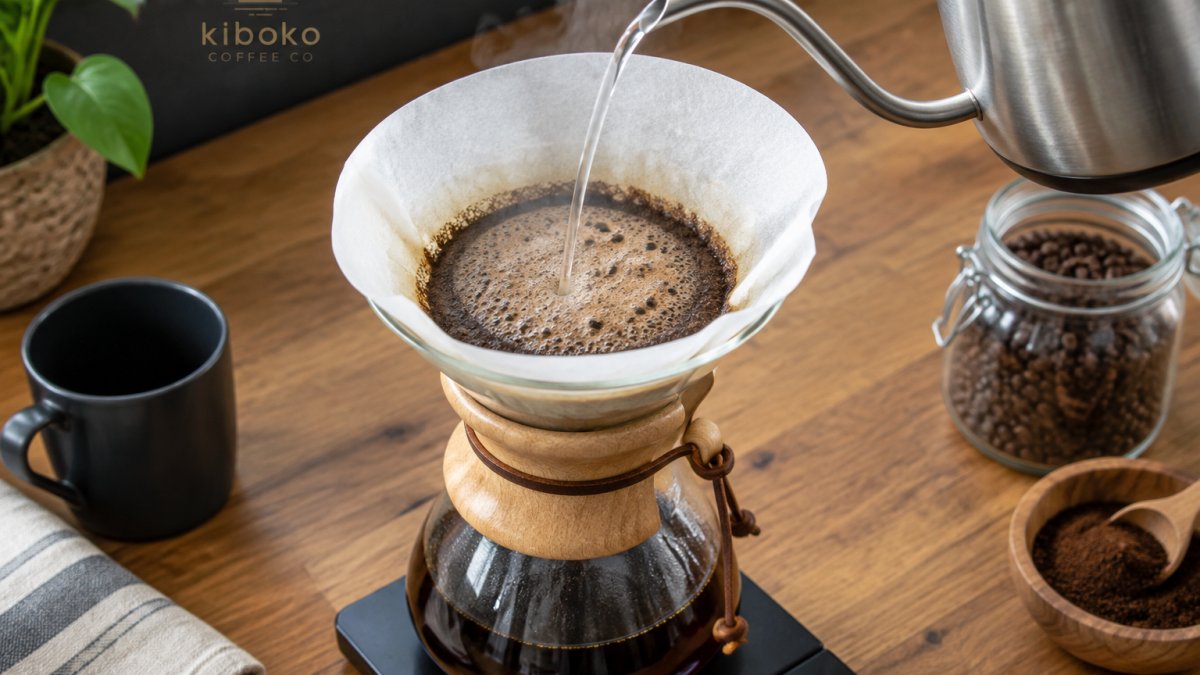
- Start the timer and bloom. Pour 60g of water over the grounds, roughly twice the weight of the coffee, and wait 45 seconds. The bed will swell and bubble as trapped carbon dioxide escapes. If it does not bubble at all, your beans are likely stale.
- Pour in stages. Add water in slow circles, keeping the bed covered. Finish all 450g by around 2 minutes 30 seconds. A workable pattern is to pour to about 200g by 1:15, to 350g by 1:55, and to 450g by 2:30, giving the bed a brief rest between pours.
- Let it draw down. The brew should finish between 4 and 5 minutes. Note the time: a finish under 3:30 usually means the grind is too coarse, and over 5:30 usually means it is too fine.
Pouring Technique in Plain Language
You do not need a specialist kettle to pour well. What matters is control, height and pattern.
- Control: pour slowly enough that you could stop mid-stream if you needed to. A fast, glugging pour disturbs the bed and pushes fines into the filter.
- Height: hold the spout roughly 5-10cm above the bed. Too high and the water splashes and digs into the grounds; too low and you cannot see where the stream lands.
- Pattern: start at the centre and spiral outwards in slow circles, staying about 2cm inside the paper filter. Never pour directly onto the paper, the water runs down the side and bypasses the coffee, which makes the cup weak and thin.
If you only have a standard kettle, pour from a low height and use a slow, steady stream rather than a gush. A common pattern among beginners without a gooseneck is to pour in short pulses, a two-second pour, a pause, then another, which gives you far more control than one continuous pour.
Chemex Troubleshooting: Fixing Bitter, Weak or Slow Brews
Chemex troubleshooting comes down to matching the symptom to the cause. Most problems trace back to grind, ratio or water temperature, and each has a simple fix. The discipline that separates a beginner who improves from one who stalls is changing one variable at a time, if you alter grind and dose together, you cannot tell which one fixed the cup.
| Symptom | Likely Cause | The Fix |
|---|---|---|
| Bitter, harsh taste | Grind too fine or water too hot | Coarsen the grind one notch, cool water slightly |
| Weak, watery cup | Ratio too low or grind too coarse | Add 2g coffee, grind finer |
| Slow drawdown | Too many fines or filter clogged | Coarsen grind, rinse filter well |
| Sour taste | Under-extracted, brew too fast | Grind finer, slow your pour |
| Muddy, silty cup | Fines passing through the filter | Coarsen grind, avoid pouring onto the paper |
Reading the Drawdown
The drawdown time is the most useful diagnostic you have. Time the brew from the first pour to the last drip:
- Under 3 minutes 30 seconds: the water is passing too quickly. Grind finer in small steps and check that you are pouring slowly enough.
- 3 minutes 30 seconds to 5 minutes: in range for a 6-cup brew.
- Over 5 minutes 30 seconds: the filter is clogging. Coarsen the grind, and make sure you rinsed the filter thoroughly before brewing.
Watch out: if your brew stalls completely, do not stir it hard to force it through. That pushes sediment into the cup and makes the flavour muddy. Coarsen the grind next time instead.
If You Do Not Own a Burr Grinder
This is the gap most beginner guides skip. A burr grinder is the ideal, but it is not the entry requirement.
- Pre-ground filter coffee is the most practical starting point. Ask for a filter grind, medium-coarse, like sea salt. The trade-off is freshness: pre-ground coffee stales far faster than whole bean, so buy in small amounts and use it within a couple of weeks of opening.
- A blade grinder can work if you pulse it in short bursts and shake the grinder between pulses to even out the particles. The result is less consistent than a burr grinder, so expect more fines and a slightly slower drawdown; coarsen your target grind a touch to compensate.
- A hand grinder is a reasonable middle step if you want whole-bean freshness without the cost of an electric burr grinder. Most practitioners find a hand grinder gives a more even grind than a blade grinder for a similar outlay.
Whichever route you take, keep the grind consistent between brews. Consistency, not perfection, is what lets you taste the effect of each change.
Scaling Your Recipe and Choosing the Right Beans
Scaling up is simple once the ratio is fixed. Keep 1:15 and adjust both coffee and water together.
Bean choice matters just as much as technique. For a Chemex, we recommend a medium roast with clear, balanced flavour. Our beginner-friendly guide to speciality beans explains what to look for.
Our own picks for filter brewing:
- Brazil Cerrado (£10.99) delivers caramel, hazelnut and dark chocolate, with a smooth, low-acidity character.
- Ethiopia Irgachefe (£10.99) brings jasmine and Earl Grey notes for anyone who wants a brighter, more adventurous cup.
Freshness is the other half of the equation. Our guide on how to keep coffee beans fresh covers storage in detail.
Shop Freshly Roasted Beans for Your Next Chemex Brew
Great Chemex coffee starts with great beans, and freshness is what separates a good cup from a memorable one. Every bag from Kiboko Coffee Co is roasted to demand and rested before packing, so it reaches you ready to brew.
Ready to put your new skills to work? The real difference in your cup comes from the beans, not just the technique. Browse our best sellers and find your next favourite.
Frequently Asked Questions
How much coffee should I use in a Chemex?
For a standard 500ml brew, use 30g of coffee to 500g of water, which gives you a 1:15 ratio. This produces roughly two generous mugs. If you are brewing for one person, halve it to 15g coffee and 250g water. Always weigh your coffee on a digital scale rather than using scoops, because bean density varies and volume measurements are unreliable. A medium-coarse grind works best with this dose.
What grind size is best for Chemex coffee?
Medium-coarse is the sweet spot, similar to the texture of sea salt or coarse sand. The thick Chemex paper filter slows the flow, so a grind that is too fine will clog it and stall your brew. If you buy pre-ground coffee, choose a filter grind, or select the cafetière option from a roaster and accept a slightly slower drawdown. A burr grinder gives you the most consistent particle size, which matters more for Chemex brewing than for most methods.
Why does my Chemex coffee taste bitter or weak?
Bitter coffee usually means over-extraction: your grind is too fine, your water is too hot, or the brew ran past five minutes. Weak or sour coffee points to under-extraction, so try a finer grind, hotter water around 94°C, or a slower pour. Check your Chemex brew time first. If the total drawdown finishes well under four minutes, grind finer. If it drags past five, grind coarser. Change one variable at a time so you can taste what actually made the difference.
How long should a Chemex brew take?
Aim for a total brew time of four to five minutes from the moment you start pouring to the end of the drawdown. The bloom stage should take about 45 seconds, then your main pours add two to three minutes, leaving roughly a minute for the final drawdown. If your brew finishes in three minutes, the grind is likely too coarse. If it stalls past six minutes, the grind is too fine or your filter is clogged.
Can you use regular coffee filters in a Chemex?
No, standard basket filters will not work. Chemex filters are purpose-made with a three-layer side that folds into a cone, and the thickness is what gives Chemex coffee its famously clean cup by trapping sediment and oils. A regular filter will not sit properly in the brewer and will let grounds through. Always buy Chemex-branded or Chemex-compatible filters, and rinse them with hot water before brewing to remove papery taste and preheat the brewer.