Quick Summary
To dial in espresso at home, fix your dose and yield first, then adjust the grind in small steps until the shot time and taste both land well. Weigh your coffee and liquid, aiming for roughly 18g in and 36g out, which is a 1:2 ratio.
- Fix dose and yield before touching the grinder, using a 1:2 ratio as a starting point.
- Aim for 36g of liquid in roughly 25 to 30 seconds with a standard 58mm basket.
- Go finer if the shot runs fast, and coarser if it runs slow, one small step at a time.
- Fix channelling by improving distribution and tamp before adjusting the grind.
- Log each shot's grind, time, yield and taste to build a recipe for each bag.
Table of Contents
- What Dialling In Actually Means and Why Your Shots Vary
- Start With Your Dose, Yield and Brew Ratio
- How to Dial In an Espresso Grinder Step by Step
- Reading Your Espresso Shot Time and Flow
- How to Fix Sour Espresso and Bitter Espresso
- Tamping, Water Temperature and Roast Level Matter Too
- Keeping Your Dial-In Consistent With Fresh Beans and Regular Maintenance
- Frequently Asked Questions
What Dialling In Actually Means and Why Your Shots Vary
Last Updated: 29 October 2026
Dialling in espresso means adjusting your grind, dose and timing until each shot tastes balanced and repeatable.
Espresso is unforgiving: a fraction of a millimetre on the grinder can turn a sweet shot sour, or yesterday's fine shot bitter today.
Shots vary because several things shift at once: grind setting, distribution and tamp, water temperature, and bean freshness. Change one and the whole cup moves.
The good news: you only need to control a handful of variables.
Start With Your Dose, Yield and Brew Ratio
Before touching the grinder, fix your dose and yield. Dose is the grams of ground coffee in the basket; yield is the grams of liquid espresso out.
The brew ratio is yield divided by dose. A common starting point is 1:2, meaning 18g in and 36g out.
- Dose: Start with 18g for a standard 58mm basket
- Yield: Aim for 36g of liquid in roughly 25 to 30 seconds
- Ratio: Keep it between 1:2 and 1:2.5 while you learn
Weigh both on a kitchen scale, guessing by eye is the most common reason home shots drift. If you are still choosing beans to practise with, see our picks for beginners.
How to Dial In an Espresso Grinder Step by Step
Grind size controls flow: finer grinds slow it and extract more, coarser grinds speed it up and extract less.
Follow these steps to dial in your grinder:
- Set your dose and ratio as described above.
- Set the grinder to a medium-fine setting and pull a shot.
- Time the shot from the moment the pump starts.
- If the shot runs faster than about 25 seconds, go finer by one small step.
- If it runs slower than about 30 seconds, go coarser by one small step.
- Taste the shot, then repeat until the time and taste both land well.
Make one small adjustment at a time; dramatic changes make it hard to tell what worked. Log each setting, shot time and taste, that log becomes your recipe for the next bag.
Watch out: a grinder that has been moved to a new setting can take a few shots to settle, so discard the first one or two before judging.
Reading Your Espresso Shot Time and Flow
Shot time is the fastest feedback you get, but it's a diagnostic clue, not a score. Two shots can both finish in 27 seconds and taste completely different, so read the clock alongside the flow and the cup.
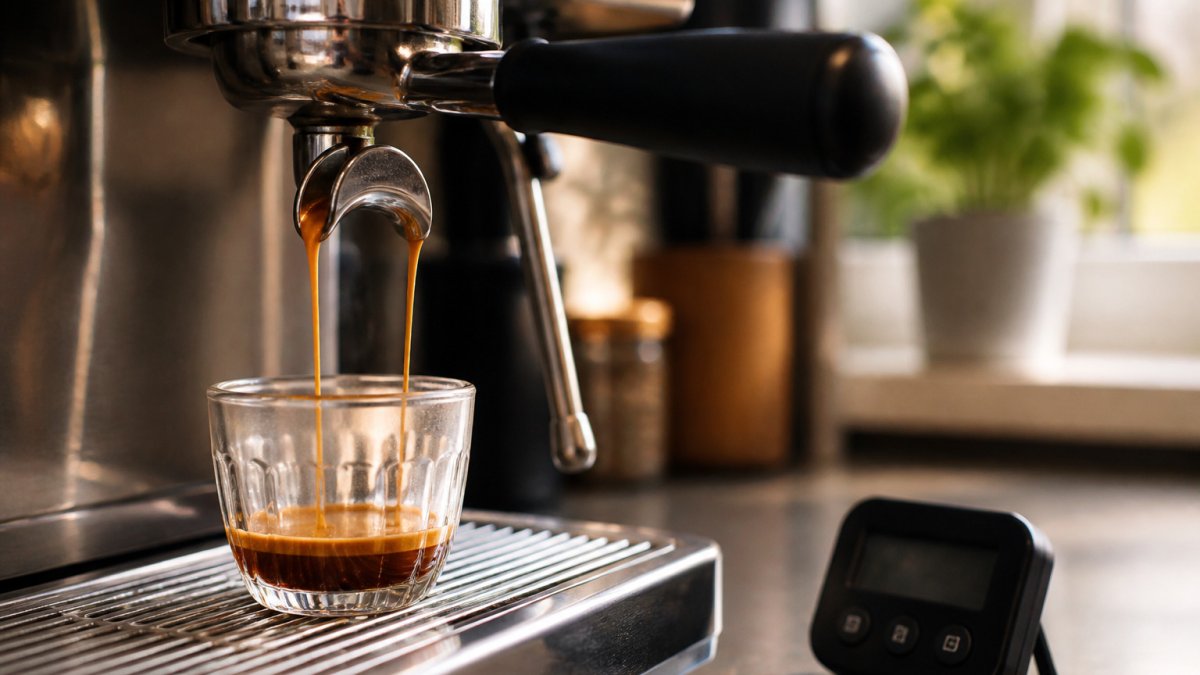
Separate the two clocks. Most home baristas time from pump start, which includes fill and pre-infusion. That number is useful for repeatability but hides what the puck is doing. Note two figures instead:
- First-drop time: how long from pump start until the first dark liquid appears. On many domestic machines this lands somewhere between 5 and 12 seconds. A very long first drop suggests the grind is too fine or the dose is too high; a near-instant first drop suggests the opposite.
- Total shot time: pump start to the point you stop the shot at your target yield. This is the number you log and compare.
Read the stream, not just the seconds. A healthy extraction usually begins as a slow, syrupy bead that darkens, then opens into a steady stream that lightens towards blond. Watch for these patterns:
- Spurting, hissing or a stream that jumps sideways: water is finding a channel through the puck. The cause is usually distribution or tamping rather than grind, so fix the puck before you touch the grinder.
- A stream that blonds early (pale and watery before your target yield): the puck is offering little resistance, often because the grind is too coarse or the dose too low.
- A stream that stays dark and thin and never opens up: the grind is likely too fine, or the basket is overloaded.
- Dripping that stalls completely: too fine a grind, too high a dose, or a basket that is clogging, back off the grind one step and re-check your dose.
Bridge what you see to what you taste. This is where most guides stop, and it is where dialling in actually happens. Use the visual as a hypothesis and the cup as the verdict:
| What you see | What you taste | Most likely cause | First move |
|---|---|---|---|
| Fast flow, blond early, thin crema | Sour, sharp, watery | Under-extracted | Grind finer in one small step |
| Slow flow, dark and syrupy throughout | Bitter, dry, ashy | Over-extracted | Grind coarser in one small step |
| Spurts, uneven colour, pale patches | Sour and bitter in the same cup | Channelling | Improve distribution and level tamp |
| Good time but flat, papery taste | Hollow, dull | Stale beans or water issue | Check roast date and water |
Treat time as a range, not a target. The 25-30 second window suits a 1:2 ratio on a standard basket, but it isn't a rule. Lighter roasts often need a longer, slower shot; darker roasts can taste best faster. If your shot tastes balanced at 22 or 34 seconds, that's your recipe, log it and stop chasing the clock.
Log three things, not one. For every shot, record total time, yield in grams, and a one-word taste note (sour, bitter, balanced, hollow). Within days you'll see which variable moved when taste changed, and dialling in stops being guesswork.
How to Fix Sour Espresso and Bitter Espresso
Sour and bitter are not opposites in the way most guides suggest.
Fix in this order. Changing several things at once makes it impossible to know what worked.
- Confirm the puck is even. If the shot spurted, or the taste is sour and bitter together, fix distribution and tamp before touching the grinder.
- Adjust the grind by one small step. Finer for sour, coarser for bitter. Pull one shot and taste.
- Adjust the yield. If the grind is close but the shot still leans sour, lengthen the yield slightly (for example 36g to 40g) to extract more. If it leans bitter, shorten it.
- Adjust dose only if the basket allows. A larger dose slows the shot and can help a sour, thin result, but stay within what your basket is designed to hold.
- Adjust temperature last. It is a fine-tuning tool, not a first response.
Sour espresso, under-extracted. Look for a thin body, sharp acidity, a fast flow and a pale, watery stream.
- Grind finer in one small step and re-taste.
- Lengthen the yield slightly to give water more contact with the coffee.
- Check that your dose is not too low for the basket, which lets water rush through.
- If the beans are very light, expect to need a finer grind and a longer ratio than you would with a darker roast.
Bitter espresso, over-extracted. Look for a dry, ashy finish, a slow flow and a dark, syrupy stream that never lightens.
- Grind coarser in one small step.
- Shorten the yield so the shot finishes before the harsh compounds dominate.
- Check water temperature, if it is running hot, bitterness climbs quickly.
- Rule out stale beans, which often taste flat and bitter regardless of grind.
| Roast level | Behaviour in the basket | Typical starting point | First fix if sour | First fix if bitter |
|---|---|---|---|---|
| Light | Dense, less soluble, resists extraction | Finer grind, longer ratio (1:2.5), slightly hotter | Grind finer, then lengthen yield | Check temperature before grinding coarser |
| Medium | Balanced, forgiving | 1:2 ratio, standard grind | Grind finer one step | Grind coarser one step |
| Dark | Porous, highly soluble, extracts fast | Coarser grind, shorter ratio (1:1.8-1:2) | Lengthen yield before grinding much finer | Grind coarser and shorten yield |
A note on water. If shots taste consistently harsh or dull no matter how you adjust the grind, check your water. Very hard water can slow extraction and mute flavour; very soft water can taste thin and sour. If you already use filtered water this is unlikely to be your problem, but it's the variable most home baristas never consider.
Keep a taste log. Note bean, roast level, grind setting, dose, yield, time and a one-word taste verdict.
Tamping, Water Temperature and Roast Level Matter Too
Once your grind and ratio are close, the remaining variables can fine-tune the shot, and this is the stage where you finish learning to dial in espresso for your own machine.
Tamping should be firm and level. Press with consistent pressure and polish the surface gently.
Water temperature affects extraction. Many home machines run between about 90°C and 96°C. Hotter water extracts more and can increase bitterness, while cooler water can taste sour.
Roast level changes how a coffee responds to dialling in.
The Nyumba Blend, a medium roast with pecan and milk chocolate notes, is a good bean to practise on. Browse it at Nyumba Blend Coffee if you want a bean that's easy to learn on.
Keeping Your Dial-In Consistent With Fresh Beans and Regular Maintenance
Once you have a great shot, keeping it consistent is the real skill. Two things matter most: bean freshness and equipment condition.
Fresh beans behave predictably, and a grind that worked last week may run differently on older beans. For a full guide, read How to Keep Coffee Beans Fresh.
Maintenance keeps your grinder consistent. Burrs wear and can change how evenly coffee grinds, shifting your dial-in without any change on your part.
For more on picking beans that suit home espresso, see Best Coffee Beans for Home Espresso. And if you are still choosing a grind level, How to Choose Coffee Grind Size walks through the options.
Dialling in takes a few attempts but gets faster every time.
Frequently Asked Questions
How do you dial in an espresso grinder?
Start with a dose and yield you can repeat, such as 18g in and 36g out. Pull a shot and time it. If it runs under about 25 seconds, the grind is too coarse, so go finer in small steps. If it runs much longer than 30 seconds, go coarser. Change one variable at a time, taste each shot, and log your settings so you can return to a good result quickly.
What espresso dose and yield should you start with?
A common starting point is 18g of coffee in the portafilter and 36g of espresso in the cup, a 1:2 brew ratio. Many home baristas then adjust toward 1:2.5 or 1:2 depending on taste. Dose depends on your basket size, so check that your basket matches the dose you are using. Keep the dose steady while you adjust the grind, as changing both at once makes it hard to see what caused a change in flavour.
How do you fix sour espresso at home?
Sour espresso usually means under-extraction. Grind finer to slow the flow, which lengthens the shot time. You can also raise the yield slightly, for example from 36g to 38g, or use water a little hotter if your machine allows. Check your tamp is level and even so water does not channel. If the shot still tastes sour after these changes, your coffee may be very light roasted, which can taste sharper at the same settings.
How long should an espresso shot take?
A typical home espresso shot takes about 25 to 30 seconds from the moment the pump starts to when the desired yield is reached. This is a guide rather than a rule, because the right time depends on the beans, dose, yield and taste. A shot that runs in 20 seconds is likely to taste sour, while one that runs past 35 seconds often tastes bitter or hollow. Use the time as a clue, then rely on taste to make the final call.