Quick Summary
Espresso yield is the weight of liquid espresso in the cup after a shot, measured in grams on a digital scale that reads to 0.1 g. Weigh the cup, tare it to zero, then stop the shot at your target weight. Weight gives a repeatable result, unlike judging the volume by eye.
- Use a scale that reads to 0.1 g, with a built-in timer and tare function.
- Tare the cup before starting the shot so only the espresso is counted.
- Calculate your extraction ratio by dividing yield by dose.
- Calibrate the scale every few weeks and after any knock or move.
- Stop the shot at your target weight, not when the cup looks full.
Table of Contents
- Why Weight Beats Volume for Espresso Yield
- Choosing a Digital Scale: The Best Coffee Scales for Espresso
- Dose vs Yield: What You Are Actually Measuring
- Step-by-Step: Weighing Your Dose and Yield
- Using Your Yield Numbers to Dial In Espresso
- Troubleshooting Yield Inconsistencies
- Booking Your Next Brew: Fresh Beans for Accurate Shots
- Frequently Asked Questions
Why Weight Beats Volume for Espresso Yield
Espresso yield is the weight of espresso liquid that comes out of the machine after you pull a shot. Most people still measure it by eye, watching the cup fill to a line. That approach is unreliable. Crema, temperature and cup shape all change the apparent volume, so two shots that look identical can differ quite a lot in how much coffee they actually contain.
Weight removes that uncertainty. One gram of espresso is roughly one millilitre, but the scale tells you exactly how much you have, every time. This is why most serious home baristas track dose and yield in grams.
Why weight matters:
- It gives the same reading regardless of cup shape or crema thickness
- It makes shots repeatable from one morning to the next
- It lets you change one variable at a time when troubleshooting
Choosing a Digital Scale: The Best Coffee Scales for Espresso
You do not need an expensive scale, but you do need one that reads to 0.1 g, responds quickly, and holds its calibration. A scale that drifts by half a gram will quietly ruin every yield comparison you make, so treat accuracy as a maintenance habit rather than a one-off purchase decision.
Look for a flat platform that fits under the drip tray, a built-in timer, and a tare function. Taring resets the display to zero so you can weigh the cup, reset, then weigh the coffee alone. Without it, measuring accurately is much harder.
Our advice for choosing a scale:
- Resolution: 0.1 g is the minimum for espresso work
- Timer: built-in timing saves a second gadget
- Size: a slim platform fits under most machine drip trays
- Response speed: a fast scale keeps up with a flowing shot
- Calibration: check whether the scale supports user calibration with a known weight
Calibrating and Maintaining Your Scale
Precision is only useful if the scale is actually accurate. Most coffee scales allow user calibration, usually with a 100 g or 500 g reference weight. Check your manual for the exact procedure, then calibrate every few weeks and after any knock or move. A cheap set of calibration weights costs little and removes the guesswork.
Humidity and heat are the enemies of load cells. Steam from the drip tray, spills, and storing the scale beside a hot machine can all cause drift. Wipe the platform dry after each session, keep the scale away from direct steam, and store it somewhere dry rather than on top of the machine. If readings become jumpy or fail to settle, recalibrate before you blame the grinder.
A simple accuracy check: place a known weight on the platform, tare, then add the same weight again. The second reading should match the first. If it does not, recalibrate or replace the scale.
Watch out: a scale that reads to 0.1 g but has not been calibrated is no more reliable than eyeballing the cup, verify accuracy before you use yield numbers to make grind decisions.
If you are weighing dose and yield for the first time, do not overthink the purchase. Any scale that reads to 0.1 g and can be calibrated will teach you what you need to know. For more on the beans you will be weighing, see our guide to Best Coffee Beans for Home Espresso: 2026 Guide.
Dose vs Yield: What You Are Actually Measuring
Two numbers drive every espresso shot. Dose is the weight of ground coffee you put into the portafilter, measured in grams before brewing. Yield is the weight of liquid espresso in the cup after brewing.
The relationship between them is what matters. An 18 g dose producing 36 g of espresso gives a ratio of 1:2. That ratio, rather than the raw numbers, is what you adjust when you want a stronger, weaker, sweeter or sharper shot.
Keep these points in mind:
- Dose stays fixed while you learn; change one thing at a time
- Yield is the output you control through grind and time
- Ratio, not absolute weight, is the number to compare across shots
Step-by-Step: Weighing Your Dose and Yield
Work through these steps in order. Once they become routine, the whole process takes under a minute.
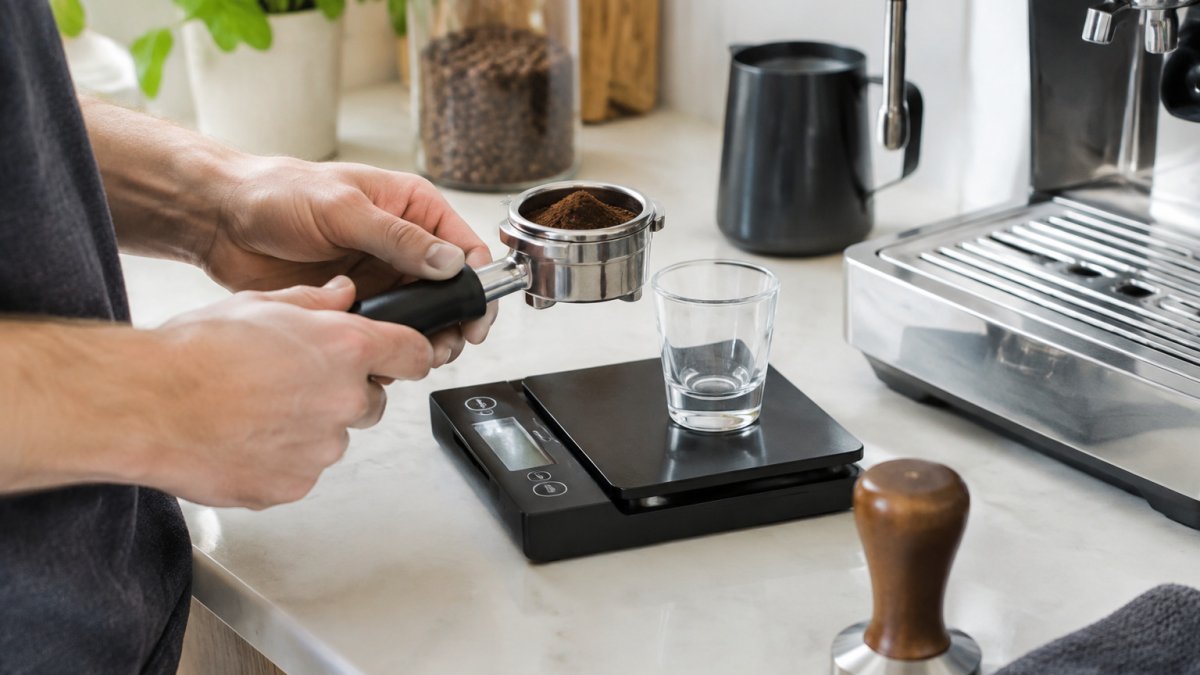
- Place your scale on a level surface beside the machine.
- Put your empty portafilter on the scale and tare it to zero.
- Grind your beans directly into the portafilter and read the dose.
- Level and tamp the grounds, then lock the portafilter into the machine.
- Place a cup on the scale, tare it, and start the shot and timer together.
- Stop the shot when your target weight is reached and note the time.
Taring the Scale and Setting Up Your Cup
Taring is the step most beginners skip, and it causes most of the early errors. Always tare with the cup or portafilter already on the platform, so only the coffee gets counted. Press tare again after placing the cup and before the shot starts, so the reading begins at zero.
Use the same cup every time while you are dialling in. Different cups hold different amounts of residual water and change the reading slightly, which makes comparisons unreliable.
Calculating Your Extraction Ratio
Your extraction ratio is yield divided by dose. If you dosed 18 g and collected 36 g, the calculation is 36 ÷ 18 = 2, so the ratio is 1:2. Most home baristas aim somewhere between 1:1.5 and 1:2.5 as a starting range, though taste should decide your final target.
Write the numbers down for your first few shots. Recording dose, yield, time and ratio side by side shows you patterns quickly. A common mistake is changing grind, dose and time all at once, which makes it impossible to tell which change helped.
The core measurements and their roles are summarised below, so you can check each step before you pull a shot.
| Step | What to do | Time or frequency |
|---|---|---|
| Place scale | Set on a level surface beside the machine | Before each session |
| Tare portafilter | Zero the scale with the empty portafilter | Every shot |
| Weigh dose | Grind straight into the portafilter and read the weight | Every shot |
| Tamp | Level and tamp, then lock in | Every shot |
| Tare cup | Place cup, tare, then start shot and timer | Every shot |
| Stop at target | Stop when target weight is reached and note time | Every shot |
Using Your Yield Numbers to Dial In Espresso
Once you can measure yield reliably, dialling in becomes systematic. The main levers are grind size and shot time. A finer grind slows the flow and extends the shot. A coarser grind speeds it up.
If a shot tastes sour and runs fast, your grind is probably too coarse, and you can try a finer setting. If it tastes bitter and runs slow, try a coarser grind. Check your yield against your target as you go, since a shot can taste different at the same time but produce a different weight.
For a fuller walkthrough of adjusting grind and time, read our guide on How to Dial In Espresso Shots at Home.
Troubleshooting Yield Inconsistencies
If your yields swing from shot to shot, the cause is usually one of a few things. Check these in order before changing anything else.
- Uneven tamping: press the grounds level and with steady pressure every time
- Inconsistent dose: weigh the dose before each shot, not from memory
- Scale drift: re-tare and confirm the reading against a known weight
- Stale or changing beans: freshness affects how beans extract, so use recently roasted coffee
A common mistake is assuming the grind is the only problem. Often the real cause is a dose that drifts by half a gram or a scale that has not been zeroed. Calibrate your scale periodically with a known weight, and keep it on a flat, vibration-free surface.
Diagnosing the Cause, Not Just the Symptom
Work from the cheapest fix to the most disruptive. First confirm the scale: re-tare, check against a known weight, and make sure the platform is dry. Next confirm the dose: weigh the portafilter before and after grinding so you know the exact input. Only then adjust the grind.
If yield is consistently low even at a fine grind, the cause may be puck degradation, channelling through cracks at the edge of the basket lets water bypass the coffee, so the shot runs fast and tastes thin. Check for uneven extraction by looking at the spent puck: holes or craters suggest channelling, which usually points to distribution or tamping rather than grind.
Pump pressure is another variable. A machine that is not reaching its set pressure will under-extract and produce low yields regardless of grind. If your machine has a pressure gauge, confirm it reaches its usual reading during a shot; if not, the issue is mechanical, not a dialling-in problem.
Yield Variations by Roast Profile
A practical starting point: keep dose fixed, then adjust yield target by roast. Treat these as starting points, not rules, taste decides the final target.
Watch out: if you stop the shot by eye instead of by weight, your yield numbers will mean nothing. Always stop at your target weight, not when the cup looks full.
Booking Your Next Brew: Fresh Beans for Accurate Shots
Accurate yield depends on fresh beans. Coffee changes as it ages, and older beans can extract differently even at the same grind and dose.
If you would rather not think about reordering, a Best Coffee Subscription for Freshness: 2026 Guide can help you keep a steady supply without running out mid-dial-in. For ways to keep beans in good condition between orders, see How to Keep Coffee Beans Fresh: A Complete Guide.
We offer four grind sizes plus whole beans, so you can match the grind to your machine from the start. Choosing the right grind size is covered in How to Choose Coffee Grind Size: A 2026 Guide.
Frequently Asked Questions
What is the ideal espresso yield ratio?
Many home baristas start with a ratio of around 1:2, meaning an 18g dose produces roughly 36g of liquid espresso in the cup. Lighter roasts often taste best with a slightly longer ratio, while darker roasts can be pulled a little shorter. The ideal figure is the one that tastes balanced to you, so treat 1:2 as a starting point and adjust in small steps, weighing each shot so you can compare results accurately over time.
Do I need a digital scale to measure espresso yield?
A digital scale is the most reliable way to measure espresso yield. Volume measurements in a shot glass vary with crema and foam, so two shots that look identical can differ noticeably in weight. A scale reading to 0.1g lets you repeat a recipe exactly, which is essential when you use the best coffee scales for espresso to dial in a new bag of beans or compare grind settings.
How does espresso yield affect the taste of my coffee?
Yield controls how far the extraction has progressed. A short yield tends to taste sour and thin because it is under-extracted, while a long yield can taste bitter, dry and hollow. Weighing your output lets you find the point where sweetness and body are balanced, rather than guessing from the colour of the crema or the time on the clock.
What is the difference between dose and yield in espresso?
Dose is the weight of ground coffee you put into the portafilter, usually measured in grams. Yield is the weight of liquid espresso that comes out of the machine. The relationship between the two, known as the extraction ratio, is the main figure you use to compare shots, and is why espresso dose vs yield is worth understanding before you change anything else in your routine.
Measuring yield by weight takes a little practice, but it turns espresso from guesswork into a process you can repeat and improve. Start with a scale, record every shot, and change one variable at a time. Get started with Kiboko Coffee Co's freshly roasted beans and see how much more consistent your daily cup can be.